

Govt to decentralise education health services
05 Oct 2023
Government will, next year, decentralise education and health sectors in order to give management the decision-making powers to enable them to manage resources and improve services.
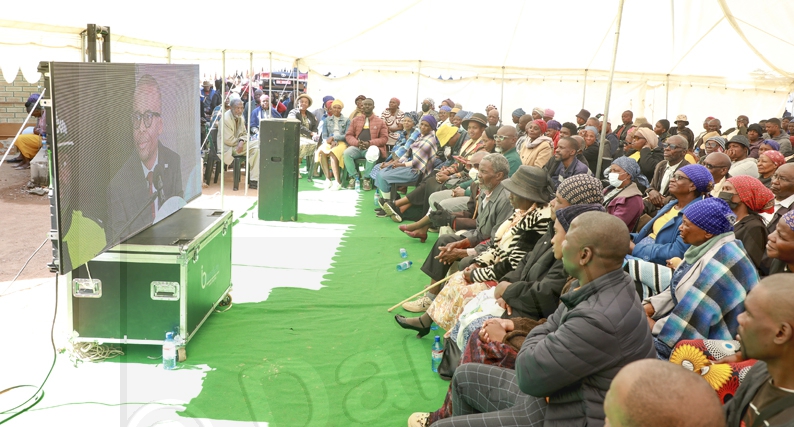
This was announced by the President, Dr Mokgweetsi Masisi at a kgotla meeting in Masunga on Wednesday (October 4).
President Masisi said currently, school heads were limited financially to run schools and therefore giving them the power to manage their resources will increase budgets and allow them to be able to effectively procure and repair resources needed in the operation and maintenance of schools.
“The same thing goes for clinics. The health sector will be decentralised so that hospital superintendents and matrons would have enough budget to run hospitals and clinics. Procuring everything through Gaborone affected effective service delivery,” he said.
Some reports show that decentralisation enables more efficient, better reflects local priorities, encourages participation and ultimately improves coverage and quality.
On one hand, there is currently a global trend to decentralise education and health services given that some governments had experienced snags of such integrated service provision, including, among others, opaque decision making, administrative and financial inefficiency as well as poor quality and access to services
By and large, it is reported that decentralisation can substantially improve efficiency, transparency, accountability and responsiveness of service provision compared with centralised systems.
On other issues, President Masisi said government would negotiate with private land owners in the North East to augment shortage of tribal land in the area.
“You have a dire shortage of land in North East. We want to do everything we can, everything in our power and might with the same energy if not more like we applied when we look at the diamond space to find land for you,” said President Masisi to the applaud of the people. It is overwhelming to reminisce on the historical fact on how you lost your land,” he said.
In another pronouncement, President Masisi said government would discuss with that of Zimbabwe to consider the use of identity cards at the two countries’ border posts, the same agreement that was recently made between Botswana and Namibia.
However, such an announcement received murmurs from some residents signaling some refute of the idea.
Consequently, President Masisi explained that the use of identity cards would not be careless because those crossing borders would be scanned.
He added that Zimbabweans had relatives in Botswana and a passport in that country was expensive, costing about USD 360 (about P4 960), a charge that many of them could not afford.
He said Zimbabweans should not be denied to bury their relatives in Botswana because they had no money to make passports.
“People shouldn’t make a mistake of thinking that the Zimbabwean situation is permanent because one day the country would prosper. Zimbabweans are industrious educated people, the most educated in Africa, hardworking, industrialised,” the President said, adding that today their agriculture had soared.
For her part and responding to questions about illegal immigrants, Minister of Labour and Home Affairs, Ms Anna Mokgethi said government encouraged safe, orderly and regular migration.
Ms Mokgethi revealed that between July and September this year, government had deported 1 170 illegal immigrants, most of whom she said were Zimbabweans and were abetted by Batswana.
She said they had engaged in joint patrols with the immigration officers, police and Botswana Defence Force (BDF).
“We are also trying to educate the nation about the dangers of entering the country at ungazetted areas and the consequences of harbouring illegal immigrants. Issues of migrations should be handled with care because they are sensitive,” Ms Mokgethi said.
Again, she said government was in the process of developing the immigration policy with International Organisation for Migration, an exercise she said was about to conclude.
On other issues she said the ministry had a challenge of people who applied for identity cards but failed to collect them.
She said there were 35 000 IDs awaiting collection by applicants and therefore encouraged those who had applied to collect them.
“An ID is needed everywhere, including banks, government offices and others. You cannot access services without producing it,” she added. ENDS
Source : BOPA
Author : Sefhako Sefhako
Location : MASUNGA
Event : KGOTLA MEETING
Date : 05 Oct 2023
Related News
28 Jul 2026
28 Jul 2026
MPs express differing views on student friendly

27 Jul 2026
Damaged Roads contributing to accidents

27 Jul 2026