


No mining licence issued for Shale gas operations
26 Nov 2013
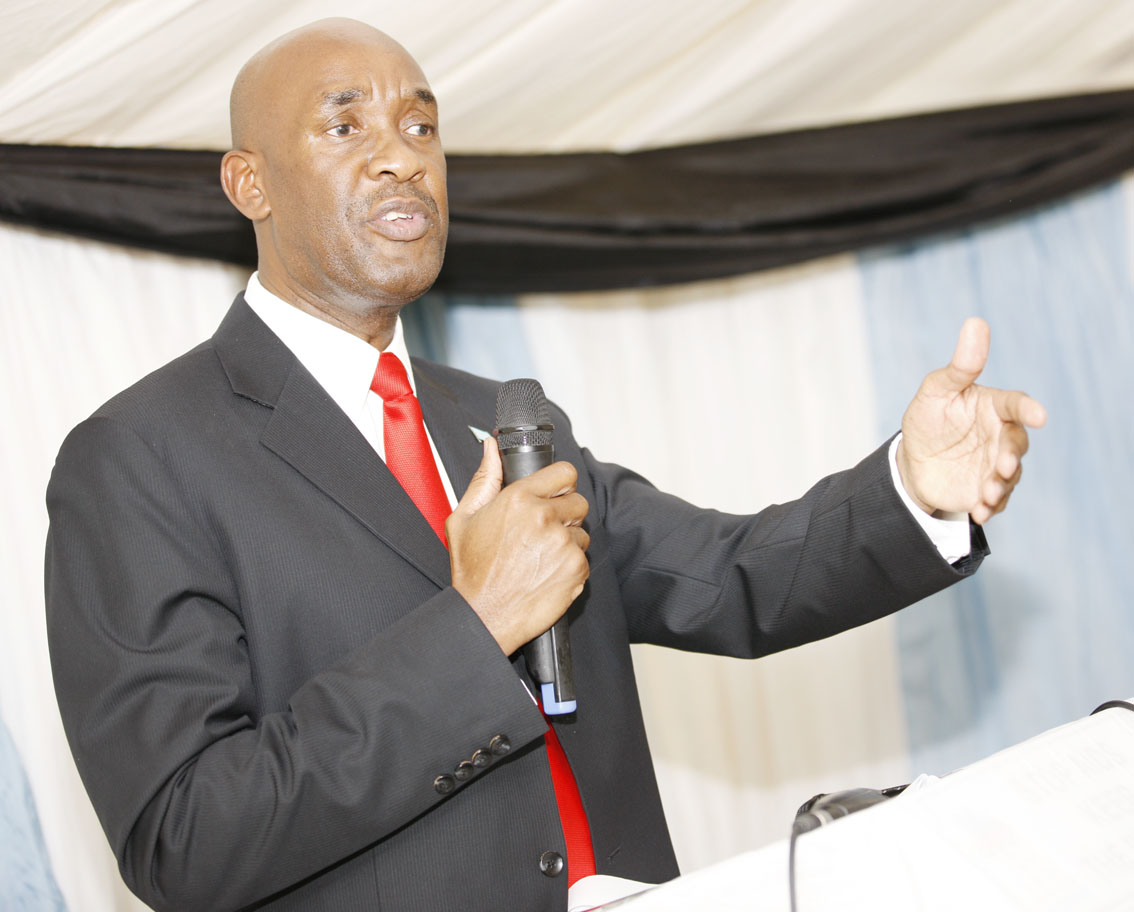
No mining licences have been issued to mine Shale gas or Coal Bed Methane (CBM) , the Minister of Minerals, Energy and Water Resources, Mr Kitso Mokaila has said.
Mr Mokaila said in Paliament on November 25 when responding to local and foreign media reports that mining licenses had been issued to mine the gases by using fracking method.
He said there had been allegations about fracking activities being carried out in Botswana, including the Central Kalahari Game Reserve (CKGR). Fracking, he explained, was a slang term used to describe processes involving sub-surface fracturing of rocks, usually through the injection of fluids to facilitate the flow of gaseous material.
However, he said several prospecting licences (PL) for CBM and petroleum were issued in different parts of the country and a few of those fell within the CKGR. Between 2001 and 2003, the Ministersaid the department of Geological Survey undertook and successfully completed a preliminary CBM exploration study to assess the availability and the potential for development of natural gas resources associated with the coal-bearing sequences of the Kalahari Karoo Basin. The results of the study, he said stimulated private investment in CBM prospecting in Botswana.
As at end of September 2012, he said there were a total of 121 PL granted for energy minerals (for coal and CBM), adding that the number, had since reduced to 88 as of October 2013. This reduction, he said was mostly due to the licences within the CKGR which were cancelled or relinquished. “The maps showing PL are published in print and electronic as public documents and therefore the issue of secrecy does not arise as alleged by the media,” he added.
He also said there was a lot of confusion regarding the terms Shale Gas and CBM, along with an array of other terms. Shale Gas, he said was a natural gas produced from a rock formation called shale. He also said Shale had low permeability, “so gas production in commercial quantities requires stimulation by fracturing (or so called fracking) to provide permeability for the gas to flow out.”
“Coal Bed Methane, also sometimes known as sweet gas, coal bed gas or coal seam gas, is a form of natural gas extracted from coal beds,” he added. To extract the gas, he said a steel-encased hole was drilled into the coal seam (at least 400 meters below ground) and pressure within the coal seams brings water and gas to the surface for extraction. Shale gas and CBM, Mr Mokaila said could be produced economically by using vertical and or horizontal drilling, and hydraulic fracking.
Horizontal drilling, he explained was the process of drilling a well from the surface to a subsurface location just above the target gas reservoir or coal seam called the “kickoff point,” then deviating the well bore from the vertical plane around a curve to intersect the reservoir at the “entry point” with a near-horizontal inclination, and remaining within the reservoir until the desired bottom hole location was reached.
Hydraulic fracturing, he said was the use of fluid and material to create or restore small fractures in a formation in order to stimulate production from new and existing oil and gas wells.
This, he said created paths that increased the rate at which fluids could be produced from the reservoir formations, in some cases by many hundreds of percentages. Both processes, the Minister said involved steps to protect water supplies. Therefore, to ensure that neither the fluid that would eventually be pumped through the well, nor the gas that would eventually be collected, entered the water supply, he said steel surface or intermediate casings were inserted into the well.
Cement sealing is done to the top of the coal seam to seal off the borehole from the water aquifer above, typical other layers on non-porous rock formations such as mudstones also prevents water from the production borehole to be in contact with aquifers above.
Therefore, with respect to prospecting activities in the country, Mr Mokaila said no current operations had been given permission to conduct hydraulic fracking. If such a process were to be carried out without authorization, he said it would be a violation of the Mines and Minerals Act of 1999 and the Environmental Assessment Act of 2011.
“Special type of explosives were however, permitted for issue to one company in Lephephe and Mashoro in 2008, 2009 and 2010. These were once off permits which are no longer valid. The explosives were used to fracture coals or carbonaceous materials on wells at depths of more than 450 meters. No fracturing has been done in the CKGR to date as alleged in the media,” he said.
The current controversy being generated in some media about so-called fracking in Botswana, Mr Mokaila said “is related to a publicity campaign to promote a documentary film by the Open Society of Southern Africa entitled: ‘The High Cost of Cheap Gas’ whose full content we look forward to seeing.”
Therefore, he said although the filmmakers apparently targeted Botswana there was no record of them ever approaching government about their allegations. He also said the motives behind the smear campaign were not yet clear. However, he said what was clear was that it was targeted at undermining the country’s progressive Mineral Development as it embarked on its mineral diversification drive.
Therefore, he said his ministry and Ministry of Foreign Affairs and International Cooperation were working around the clock to ensure that government officials attended the launch, after which he would come back to give a full brief in parliament. He also appealed to MPs to collectively defend the sovereignty of the state against the smear campaigns against the country for the betterment of the quality of Batswana’s lives. Ends
Source : BOPA
Author : Lorato Gaofise
Location : GABORONE
Event : Parliament
Date : 26 Nov 2013
Related News

25 Aug 2026
Forensic audit generates 90 priority actions
25 Aug 2026