



Attorney questions confession statement authenticity
10 Jul 2022
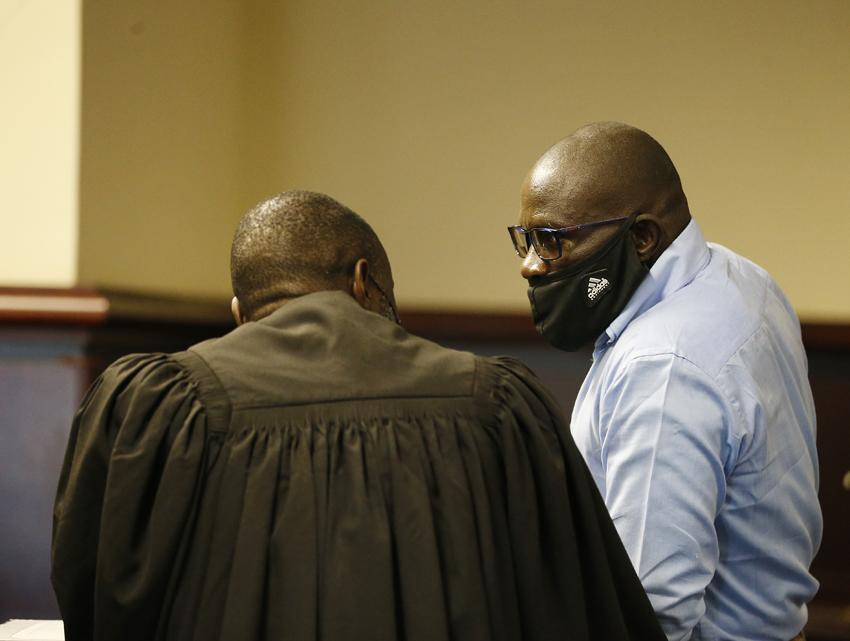
A murder trial before Judge Michael Leburu at Gaborone High Court came to a halt on Friday when one of the defence attorneys’ Mr Letlhogonolo Makgane questioned authenticity of a confession statement purported to have been from his client.
Court had to temporarily divert focus from the main case and conduct a trial within a trial.
The defence attorney said the confession statement purported to have been recorded from Hamadi Mkhuha was unlawfully recorded, therefore must not be admitted as part of the prosecution evidence.
In his objection, he said the confession was neither freely nor voluntary made as the investigating officer, Detective Senior Superintendent Sergeant Marapo had promised to turn his client into an accomplice witness.
His second reasoning against the purported confession statement was that it was not recorded in the language used by the accused person.
Mr Makgane said his client delivered the confession statement in Shona whereas it was recorded in English.
Mr Makgane said the confession statement also cast an element of doubt on whether it was done freely as his client had stated that the investigator wanted to make him a state witness.
“He said it at the end my lord. The statement must be read in totality and it does not matter whether the inducement was made. What is sufficient is that he was promised to be made a witness,” he said.
He said the confession was supposed to be recorded in its original language (Shona) and translated later.
Therefore, Mr Makgane said the confession statement presented before court was not in its original form.
“We submit that the purported confession statement was not freely made. The state dangled a carrot before my client. He was promised to be made a state witness. Procedure was not followed in recording the confession statement. We pray that the purported confession statement must not be admitted before this court as part of the prosecution evidence,” he said.
For her part, the prosecutor said for a confession statement to be admitted as evidence, it must have been done freely and voluntarily.
“The person making it must be in their sound and sober sense, must not have been unduly influenced. Such a confession must be made before a judicial officer,” said Ms Mokgosi.
She said the law did not make reference to the confession be recorded in the language spoken by the person making it.
“We submit that we have proved beyond reasonable that the confession was made freely and voluntarily and that it must be admitted as part of our evidence,” said Ms Mokgosi.
The prosecution team called two witnesses being Chief Magistrate Gaseitsiwe Tonoki and Mr Stern Kapfavira who was the Shona interpreter when the confession was recorded in 2018.
Mr Tonoki, who was by then based at Broadhurst Magistrate Court, confirmed that the confession statement was not recorded in the language that was used by Mkhuha.
He said on February 20, 2018, Mkhuha was brought to his chambers at Broadhurst Magistrate Court by Detective Constable Matladi to make a confession statement.
“He introduced himself as Hamadi Mkhuha and confirmed he had come to make a confession statement,” he said.
Mr Tonoki said Mkhuha also confirmed that he was doing so willingly and was not under any form of duress.
Satisfied that the accused person was not forced, under any form of influence or threatened by any form, Mr Tonoki said Mkhuha was given an opportunity to deliver his confession statement.
Since the confession was delivered in Shona, he said a Shona and English interpreter was engaged to translate for either of the parties.
“He delivered his confession in Shona and it was translated for me into English as I was recording in English. I would ask him questions in English and they will be translated into Shona,” said Mr Tonoki.
He said the process of recording Mkhuha’s confession statement was done in accordance with the law, guided by section 228 and 231 of the Criminal Procedure and Evidence Act (CP&E Act). “He appeared to be in a sober and sound mind. The statement upon completion was read back to him and he confirmed it to be true,” he said.
Mr Tonoki confirmed to the court that his interaction with Mkhuha was reliant on the interpretations made by the interpreter.
Though it appeared at the end of the recorded statement that Mkhuha had mentioned that Mr Marapo said he wanted to make him a state witness, Mr Tonoki said that version of the statement was never made prior to recording the confession.
Mr Tonoki also said he was not aware that the interpreter was also supposed to record the confession statement in its original form.
“I do not recall the Shona interpreter recording what was said in Shona. According to my understanding recording a confession in the original language was a matter of practice not law,” said Mr Tonoki.
He further said he was not aware Mkhuha was promised to be made a state witness and that a fine of P1 500 against his wife for over staying in the country would be cleared.
He said he was also not aware that Mr Marapo had is his custody Legwale and Dzwicha, therefore the accused was forced to make the confession statement to incriminate them.
A Shona interpreter engaged during the recording of the confession statement, Mr Kapfavira (65) a Zimbabwean national and retired army employee in his native country described himself as an adhoc interpreter with an experience span of more than 20 years in English, Shona and Ndebele languages.
He recalled that Mkhuha made the confession voluntarily and had confirmed prior to recording that he was not under any form of duress.
He confirmed that when the confession was made, he started recording, only to stop along the way as he was lagging behind in translation.
“My job on that day was to translate not to record. I recorded a statement with Broadhurst Police to confirm that I was engaged on behalf of Mkhuha, a Zimbabwean national who speaks Shona and wanted to make a confession statement before Mr Tonoki,” he said.
Judge Leburu will deliver the ruling in relation to the contended confession statement on October 24.
Ernest Legwale of Phaphane ward in Mochudi is alleged to have plotted to murder his former wife (Dimpho Meswele), alongside two Zimbabwean men, Mkhuha and another still on the run.
Particulars of the offence are that Legwale is alleged to have hired hit men (Mkhuha and another not before court) who accidentally murdered the wrong person being Thato Meswele who is the younger sister to Legwale’s former wife, Dimpho.
The two accused persons and another who was still on the run, are said to have on or about September 10, 2015 at or near Oodi in the Kgatleng Administrative District, acting jointly and with a common purpose, unlawfully assaulted Thato Meswele inflicting serious injuries on her, from which she died on the September 14, 2015.
Mkhuha is also facing another count of unlawful stay in the country.
The first accused person, Legwale is represented by Mr David Ndlovu of Ndlovu and Company. The trial will continue on October 24. ENDS
Source : BOPA
Author : Moshe Galeragwe
Location : GABORONE
Event : Court
Date : 10 Jul 2022
Related News
16 Sep 2026
14 Sep 2026
Magistrate grants murder accused bail

11 Sep 2026
Armed robbery suspects on bail
10 Sep 2026