


ORASECOM empowers Struizendam beneficiaries
08 Mar 2022
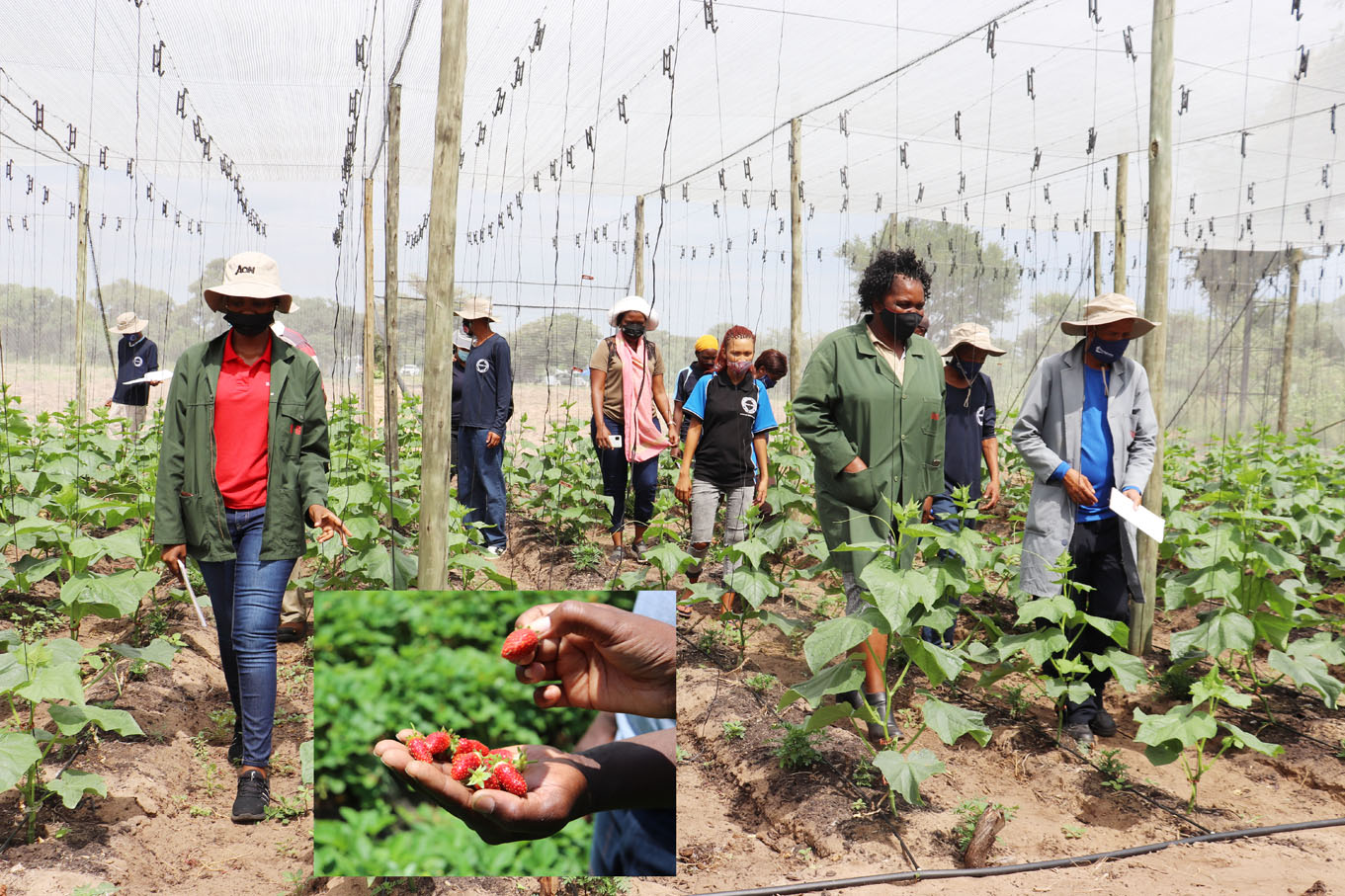
Following government response in September 2020 to construct multimillion Pula water desalination plants in Rappelspan and Struizendam to end water woes in the BORAVAST cluster in Kgalagadi, eight beneficiaries were in Shakawe and Maun on a horticulture benchmarking mission.
From Kalahari Desert to a wetland area, beneficiaries braved scorching heat traversing the country from Struizendam in the Southern part of Botswana to North Western part covering over 1 000km on a mission to learn from horticulture production farmers who benefitted from Okavango River Basin Water Commission (OKACOM).
“We have brought them here to draw inspiration, gain insight, and expose them to first hand practical knowledge from the farmers here. We are looking at instilling mindset change so that the beneficiaries could leave here stimulated to transform their livelihoods through horticulture.”
“We wanted to carry out the operation in the country, to promote inter-cultural exchange so that beneficiaries can see that it is possible done by Batswana just like them to promote food security in the area of horticulture to encourage food self-sufficiency,” said Orange Senqu River Commission (ORASECOM) representative Mr Michael Ramaano in an interview.
He said water was a critical resource in all sectors of the economy thus the construction of multi-million water desalination plants in Rappelspan and Struizendam to improve availability of portable drinking water in the area and assist communities to produce much needed vegetables which were produced in extremely limited quantities in the Kgalagadi area.
He said governments of Botswana, South Africa, Lesotho, and Namibia signed ORASECOM agreement to equitably share the water resource. The river basin runs through Lesotho, trickling down through South Africa, Botswana and Namibia.
Department of Water and Sanitation official, Mr Botsalo Thamuku said the aim of the benchmarking exercise was for beneficiaries to gain first-hand experience from their counterparts involved in horticulture projects in the North western part of the country who had benefitted from OKACOM which manages the river basin of the riparian states of Botswana, Angola and Namibia.
Shakawe sub-district crop production officer, Ms Elizaberth Keabetswe, said the coming of the beneficiaries from Struizendam to Shakawe would be helpful for beneficiaries to exchange notes, build networks, and create granaries of knowledge which they could tap into in their journey of horticulture production. She said in the area six farmers funded under OKACOM facilitated by United Nations Development Programme and Global Environment Fund were doing exceptionally well despite challenges.
Ms Keaketswe noted that assessments carried out from Nxamasere to Bodikwa revealed that market was not a challenge in the area. However farmers continued to fail to meet demand of horticultural produce.
Some farmers, she noted, had grown tomatoes, yellow and red pepper, strawberry and cucumber which are in high demand in the tourism area.
“Farmers are growing them but still the demand is high, market is not the issue, but the challenges they face as farmers,” she said.
Sharing knowledge with the beneficiaries, cucumber farmer in Shakawe Benny Murundu said he was assisted with shade nets and Youth Development Fund (YDF) assisted him to procure irrigation pipes, drip irrigation system, diesel pump whilst the ministry officials taught him climate smart farming moving him away from conventional methods to produce high value crops with minimal costs.
The officials also taught him how to deal with pests by destroying them in an organic way such as dealing with nematodes using marigold flower.
A couple at Samochima village Mr Mothare Mohembo and Ms Wandipa Adzina, have an integrated farm where they are involved in Agro tourism, landscaping, rearing small stock, growing strawberries, said business was good.
They expressed concern that local shops procured strawberries from outside yet they were available locally.
Ms Adzina said they sell strawberries to lodges and they will soon introduce strawberry picking activity.
A beneficiary from Struizendam Mr Jan Abrams appreciated the experience as it had been an eye opener, “baie dankie. Ek waardeer. Ek het baie geleer,” he said in Afrikaans meaning thank you very much I appreciate I have learnt a lot.
He learnt that the farmers at Shakawe were doing things differently and they shall replicate some of the horticulture farming methods to deal with pests and increase production.
They shall also pick a ‘few leaves’ from various farms and see how they infuse that at a farm in Struizendam taking into cognizance the varied climates.
For him, it was the first time to interact with such a farming community, noting climate smart farming approaches.
Youthful Mr David Gooi gained a lot of experience as it was his first time seeing such horticulture projects.
He learnt that they could also use eco-friendly fetilizer such as kraal manure rather than buy manufactured ones. Ends
Source : BOPA
Author : Calviniah Kgautlhe
Location : SHAKAWE
Event : Interview
Date : 08 Mar 2022
Related News
08 Aug 2026

07 Aug 2026
Xiplomacy Hosting the world building the future

07 Aug 2026