


Donkey cart woman transcends gender stereotypes
28 Jul 2021
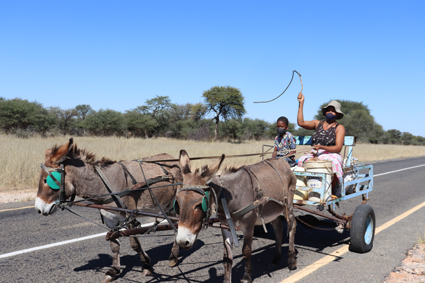
Draped in a floral skirt and a tank top, 42-year-old Ms Thando Brooks of Makopong in Kgalagadi District cheerfully holds the reigns of a single-base donkey cart in a rather warm winter afternoon.
The hoofed tag team of Sledgeman and Tsebe gallop eagerly as the two-wheeled donkey cart hurtles along the main road near Makopong where Ms Brooks and her son Steve rock on a double seater.
She sits studiously behind the saddle harness, straps and cruppers carefully controlling the pace of the donkeys. Under their seat and beyond are typical plastic water containers and some are stashed with berry leaves acting as leads to stop the water from splashing over. Interestingly, donkey carts are a common sight in the remote areas.
They occasionally wind their way to their destinations at a pace appropriate for rural communities.
They are an integral part of the rural lifestyle and culture ferrying people from village to village, and carrying essentials such as firewood and water, transport to clinics, shops and children to school.
The sight of a woman holding the reigns is uncommon in Kgalagadi. Clearly, Ms Brooks is an exception.
She has been able to to pass the test of scorn, transcend traditional gender boundaries and thrive in a male dominated practice.
The two donkeys, Sledgeman and Tsebe are to Ms Brooks what the engine of your Totoya Hilux or Mazda is to you.
“The donkeys have been my salvation over the years, as I use them to collect water, fetch firewood, buy groceries, and go to a clinic,” she said.
And no, Ms Brooks is not the first woman to drive a donkey cart.
She actually learnt the ropes from her 70-year-old mother who imparted the knowledge to her as a child. To date the old woman can still hold the reigns.
She taught Ms Brook’s a a lifestyle that made no distinction between male and female, thus her ordinary existence doing what many consider to be the man’s task,which everyone should really learn irrespective of gender orientation.
The Makopong born and raised Ms Brooks says with the knowledge imparted to her from a tender age and her experience so far, she does not need to have boys or men around to help her hitch and harness the donkeys.
“When you know how to do it you cannot struggle, and you must also teach your children!”
Ms Brooks is however painfully aware that there are certain tasks she cannot do as a woman. For example, sometimes the donkeys go deep the thick, and that’s not a lone woman’s place.
“In such cases I will be forced to wait for them to return and may not be able to do what I had wanted to do in time,” she says.
Nonetheless, Ms Brooks encourages women to stand up for themselves and believe in themselves.
She uses the donkey cart to buy medicines for her livestock, which she was given under the government poverty eradication programme and hopes that over the years her life will improve.
With the continued rise in fuel prices, increasing cost of living and high cost of motor vehicles, she said people in rural areas were gradually depending more on donkey carts for transport.
“It does not cost any money to use donkeys. Besides, donkey transport has survived for centuries providing a vital form of affordable non-motorised transportation” she said. ENDS
Source : BOPA
Author : Calviniah Kgautlhe
Location : MAKOPONG
Event : Interview
Date : 28 Jul 2021
Related News
08 Aug 2026

07 Aug 2026
Xiplomacy Hosting the world building the future

07 Aug 2026