


Commercialisation way to food security
27 Jul 2021
“Agriculture is a business not a hobby” is a dictum Botswana University of Agriculture and Natural Resources (BUAN) vice chancellor, Dr Jasper Rees, wishes
Batswana farmers, many of whom still leave farming for weekends and farms solely in the hands of workers, could adopt.
Having recognised the importance of commercialisation to the attainment of food security in Botswana, Dr Rees and his team are working on positioning BUAN to drive creation of a successful agricultural industry in the country.
Commercialisation is therefore a key strategy for the organisation, which boasts two companies, BUAN Enterprises and BUAN Consult, aimed at generating income to augment its annual subvention.
The university, which endeavours to deliver market-ready graduates, has also undertaken to engender entrepreneurship by introducing a three-year graduate programme, which started with 29 participants last year.
Upon graduation, the entrepreneur trainees, who were recruited through an internal advert, are expected to either establish their own or manage others’ commercial agriculture or natural resources businesses.
They come from different fields, 13 of them holding BSc Soil and Water Engineering, seven BSc Animal Science, three BSc Range Science, two each BSc Agriculture and BSC Agricultural Mechanisation and one each BSc Food Science and Technology and BSc Agricultural Economics.
As part of the programme, 12 are working in horticulture, six with broilers, four with herbs and mushrooms, three are in pig production with two each in layers and dairy.
They learn entire production processes from planting to weeding, pests, diseases and marketing. Although still in its infancy, the programme is already producing vegetables on 9.25 hectares, herbs on 0.10 hectares and two 4x4 metres mushroom houses.
Some 900 chickens have been sold to Tswana Pride by the broiler production enterprise while plans are underway to acquire 4 500 chicks to fill three broiler houses. Currently there are 495 layer pullets, with the aim of expanding to 1 100, collecting 460 eggs daily.
The pig enterprise has 55 pigs and piglets while the two dairy incubates take care of 160 dairy cows with 120 more expected.
“The benefit is in playing a role in developing entrepreneurs, especially for the agriculture and natural resources industries.
This is intended to assist the Government of Botswana with creation of employment through self-employment by the graduates who will have technical capacity and business acumen to establish commercial enterprises, which can create employment for others.
This will also help the country to reduce its import bill, especially for agricultural produce,” explains Dr Rees in response to a questionnaire. BUAN has partnered with Local Enterprise Authority (LEA) on the programme to empower participants “to do agriculture at its best”.
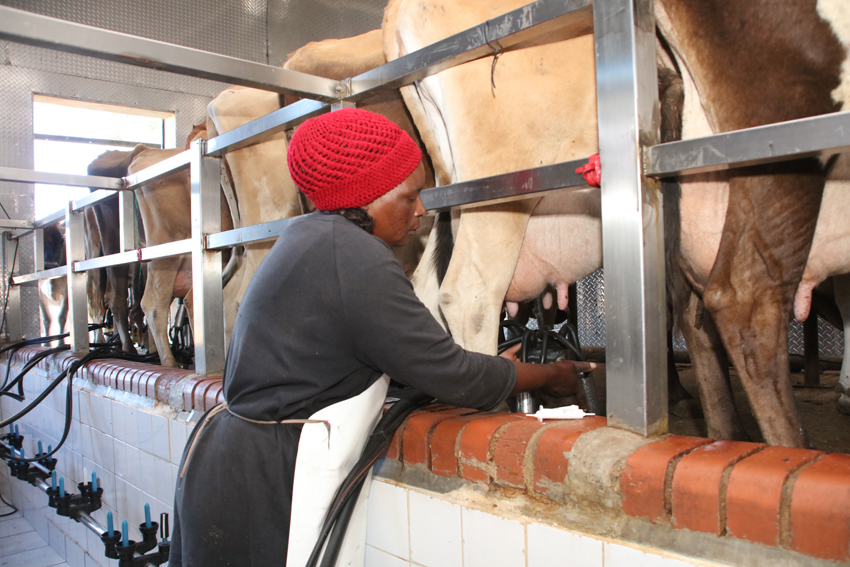
In another partnership, BUAN has engaged, Mr Peter Schutte, and wife Louise in its dairy farming venture which doubles as a training facility to give both students and entrepreneur trainees vital practical experience.
Students come on a daily basis and according to Mr Schutte, are loving the experience. “They can put their arm right inside there to see if a cow is really pregnant,” he says.
The partner serves as a dairy farming and processing instructor as well as manages both BUAN herd and their own, expected to total 280 with the delivery of more cows purchased by the university at a cost of P2.2 million. “We will have more than 250 Jerseys, which perform better than other breeds in Gaborone’s hot climate.
That will make us the second largest dairy operation in the country after Sunnyside,” says Mr Schutte.
Dr Rees explains that BUAN, which was looking for a farmer keeping more than 100 milking cows and also involved in milk processing as well as producing the likes of yoghurt, butter and cheese, identified the Schuttes through profiling Botswana dairy farmers.
The partnership saw the Schuttes relocating from Pitsane to BUAN Farm about six months ago and already calves have been born there solely through artificial insemination. Only females are kept and a few males mainly for genomic purposes.
Through genomics, scientists based in Stellenbosch, South Africa can with just one hair from a bull’s tail, tell even the quantity of milk its offspring would produce.
“With such information, when you sell someone a bull, they know exactly what they are buying,” says Mr Schutte.
Milking is done twice a day and production currently stands at 1 800 litres daily bought mainly by Clover. The milk revenue and costs are shared on pro-rata basis between BUAN and the partner. Other products from the farm are yoghurt, drinking yoghurt in three types of flavours, sour milk (madila) and expensive cheeses such as Italian ricotta.
Ms Schutte, who is in charge of this side of the business, says BUAN cafeteria is her main customer but also gets orders from individuals and shops.
In a bid to contribute further to the country’s food security, BUAN is conducting some experiments including with safflower, believed to have originated in the Middle East, and dryland rice from China.
According to Dr Rees, the safflower trial is part of a much longer project on exploring its possibilities as a new crop explaining that there has been a lot of small-scale testing of different varieties of the plant. Safflower, which has value as an oilseed crop as well as animal feed, is grown in more than 60 countries around the world including India, US, Mexico, Ethiopia, Argentina and Australia.
The dryland rice experiment, undertaken in partnership with African Agriculture, a private company, has been declared a success because out of the seven different types of Chinese rice seeds planted last December, three yielded a crop that was harvested in April.
The experiment is set to continue this October with the three successful seeds to determine which one is suitable for the Botswana climate.
It will also be extended to Maun, Tuli Block, Jwaneng, Pandamatenga and Barolong Farms to determine which was ideal to each area.
Other experiments include with Syngenta (a Chinese science-based company helping farmers to grow safe and nutritious food while taking care of the environment) horticulture seeds which are about to commence in partnership with a company called Agrizor while a small maize seed trial is ongoing.
In terms of partnerships, BUAN is pursuing one on lab soil testing while collaborations on renewable energy, meat processing and wholesale at its Lobatse campus, Meat Industry Training Industry (MITI) are ongoing.
To augment stock feed and reduce costs, Lucerne, a major protein for dairy animals, is now being grown on BUAN Farm and is currently planted on 24 hectares.
As a way of promoting professionalism and commercialisation beyond the campus, BUAN’s Centre for In-service and Continuing Education offers over 30 short courses facilitated by its staff both at Sebele and MITI where new courses, such as diploma in leather production, are being developed to support the Lobatse Leather Park.
The courses are grouped into five categories namely animal production/management and feeding, agribusiness, crop production and horticulture, soil, water and machinery as well as information technology and research methods.
Courses offered under the agribusiness category include business proposal, farm records and accounts, marketing of agricultural products, extension techniques and the newly-introduced value chain management.
Another new course is soil fertility and fertiliser management under the crop production and horticulture category.
Fees range from a little over P2 000 to around P4 700 per week depending on whether they are residential or without accommodation.
Dr Rees says the university is now moving towards running the courses online as necessitated by the new normal, which would enable expansion beyond Gaborone and its environs.
Most of the courses are a week long, some are certificated but all enable participants to practise as professionals, explains Dr Rees.
The 52- year-old institution, which was established as Botswana Agricultural College in 1967 then transforming into Botswana College of Agriculture before assuming its present identity, continues to reinvent itself.
Currently undergoing rebranding, its new identity is expected to open doors to future endeavours especially in entrepreneurship development, job creation and sustainability as well as commercialisation.
It seeks to increase the university’s focus on research and entrepreneurship, which is essential for producing the graduates and knowledge required to develop agriculture and ensure food security for the nation.
In a bid to develop research capability, the institution has embarked on a recruitment drive for professors to increase its staffing complement to 150, a 30 per cent increase and is also in the process of procuring equipment and expanding its post-graduate programme thanks to a 35 per cent budget increase.
Of the budget increase under the current budgetary constraints induced by the COVID-19 pandemic, Dr Rees says, “It is testimony to the support that we are being given”.
A line department in the Ministry of Agricultural Development and Food Security, BUAN is connected to the Ministry of Tertiary Education, Research, Science and Technology through student allowances and Ministry of Environment, Natural Resources Conservation and Tourism due to its natural resources mandate.
He says relationships with the other two ministries need to be developed.
Decrying lack of proper research funding streams in Botswana, which he says is the institution’s main challenge, Dr Rees has called for the establishment of a national research financing agency to manage competitive demands.
The BUAN vice chancellor says because of the limited amount of money going into it, people undertake research for their own benefit and in addition, funding organisations determine priorities.
“If TB is considered a priority, that’s where the money will go” to the detriment of national priorities such as food security. ENDS
Source : BOPA
Author : Kebareng Solomon
Location : GABORONE
Event : Interview
Date : 27 Jul 2021
Related News

08 Aug 2026

07 Aug 2026
Xiplomacy Hosting the world building the future

07 Aug 2026