


Seretse Khama Building Botswana and the Frontline States in Difficult Times
29 Jun 2021
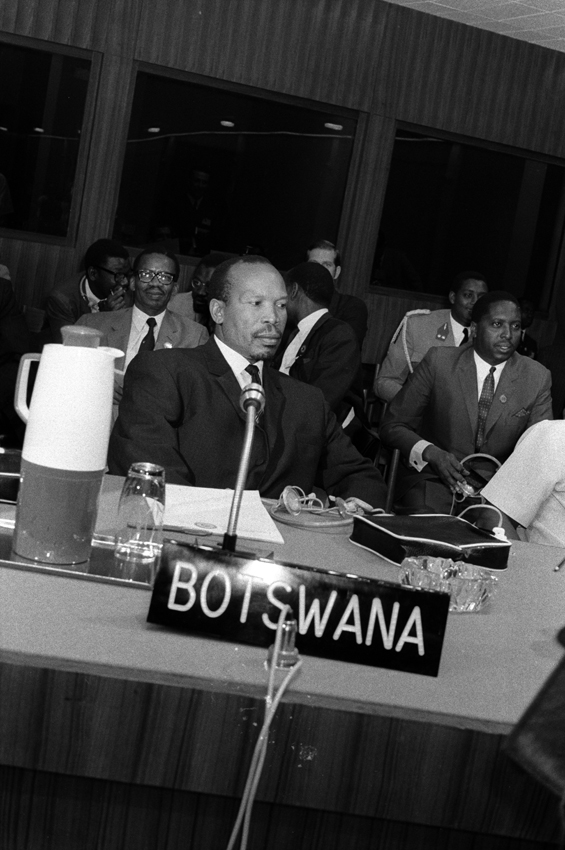
The monumental rise of Botswana from the independence era ashes as one of the poorest, least developed nations in the world to middle income status; plus Southern Africa’s march towards democratic governance, owes in part to the vision and effort of founding President Sir Seretse Khama.
When he led the transitional government as Prime Minister of Bechuanaland when the country became a nominally self governing territory after the first general election of March 1965; and later when he took the oath of office as the first President of a now fully independent Republic of Botswana on September 30 1966, Sir Seretse and fellow leaders faced huge challenges.
In his address to a seminar addressed by the Dag Hammarskjöld Foundation and the Scandinavian Institute of African Studies in Uppsala, Sweden on November 11, 1970, Sir Seretse outlined that despite the enormity of the task the country faced, Botswana was able to navigate a path to progress.
“Botswana emerged as an independent, sovereign democracy capable of making it’s own distinctive contribution to progress in Southern Africa,” he said.
Narrating how Botswana’s geographical position itself posed a challenge, “hemmed between the minority ruled territories of Rhodesia, South West Africa and (apartheid) South Africa, with only a narrow and disputed frontier with independent Africa (the 150 metre boundary with Zambia at Kazungula)” Sir Seretse outlined the risks his nascent state faced at independence
This was compounded by Botswana inheriting very little physical and social infrastructure from decades of colonial rule.
“Roads and telecommunications, roads and power supplies were totally inadequate to provide a base for industrial development,” Sir Seretse said.
He then added; “the colonial government failed to recognise the need to train and educate our people so they could run their own country.
The colonial government during the whole period of British rule never completed a single secondary school. Nor did we inherit any institutions for vocational training even at the lowest level of artisan skills.”
Instead of wallowing in self-pity, Sir Seretse insisted his government would get down to the business of working on transforming the country that, adding, “my description of the situation in which we found ourselves at independence is not intended to convey an appeal for sympathy or a desire to identify scapegoats.”
His government identified three assets- “first, the discovery of mineral assets just after independence, to reduce and eventually end our reliance on external aid; second, our boundary with Zambia, which provided a physical and psychological link with our brothers in independent Africa; and third and most important- the character of the Batswana.”
Four national principles- democracy, development, self-reliance and unity were adopted (a fifth, botho later added) and Sir Seretse explained that these ideals would carry Botswana forward.
“Our revolution is peaceful and positive in its goaIs. But it is nonetheless real for consisting of small victories over the ever-present enemies - poverty, ignorance and disease. Nor do we regard it as a struggle for ourselves alone, but a contribution to the establishment of self-determination and non-racial democracy throughout Southern Africa,” Sir Seretse said.
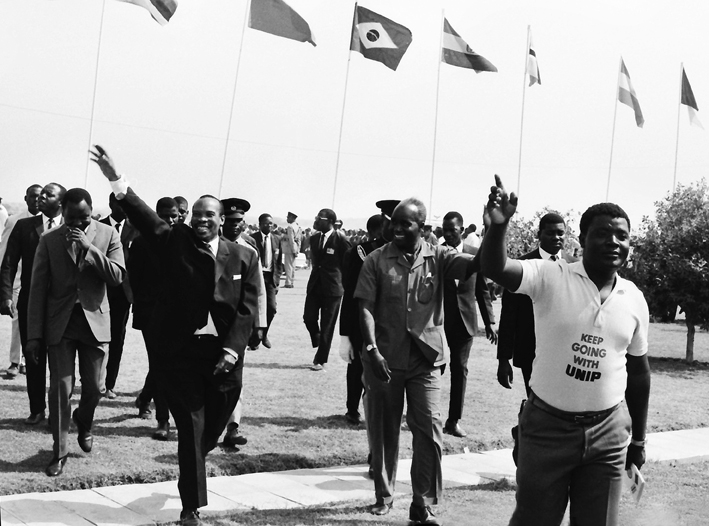
In this regard, Sir Seretse worked with fellow presidents, Dr Kenneth Kaunda of Zambia and Julius Nyerere of Tanzania in establishing the Frontline States, a body of independent Southern African states assisting liberation movements and using diplomatic channels to agitate for the independence of Angola and Mozambique from Portuguese rule; as well as South Africa, South West Africa (Namibia) and Rhodesia (Zimbabwe) from white minority rule.
Joined by Samora Machel of Mozambique and Angola’s Augustino Neto after the two former Portugal colonies’ independence in 1975, the Frontline States leaders played a part in the
Zimbabwean struggle for independence, partaking in the negotiations at the Lancaster House in London, United Kingdom.
As Zimbabwe achieved independence in 1980, the Frontline States, now including Lesotho and Swaziland (now Eswatini) founded the Southern African Development Coordination Conference (SADCC), to work on pooling their economic resources to reduce economic dependence on apartheid South Africa.
SADCC later became the Southern African Development Community (SADC) in 1992, changing focus to regional integration after Namibia had become independent in 1990, while South Africa worked on dismantling apartheid architecture ahead of the historic 1994 democratic elections that ushered in Nelson Mandela as president.
In April 1980, Sir Seretse became the first SADCC chairperson in 1980, and from that year to date Botswana became host to the secretariat of what is now SADC.
Decades later, with Botswana now a middle-income country, still with challenges of a developing state but having made giant leaps from the impoverished state of the mid-1960s; and Southern Africa now liberated as a whole, the legacy of Seretse Goitsebeng Mmaphiri Khama remains. Ends
Source : BOPA
Author : Pako Lebanna
Location : Gaborone
Event : Sir Seretse Khama Centenary celebration
Date : 29 Jun 2021
Related News
08 Aug 2026

07 Aug 2026
Xiplomacy Hosting the world building the future
07 Aug 2026