


Sir Seretse A true proponent of self-reliance
29 Jun 2021
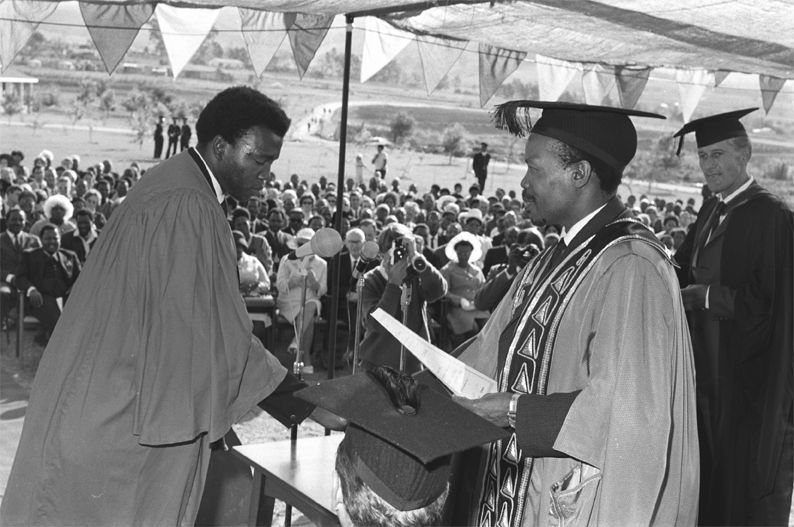
When Lesotho unilaterally decided to pull out of the tripartite Botswana, Lesotho Swaziland (BOLESWA) education partnership in 1976, Botswana had no choice, but to look within to create what we today call the University of Botswana (UB) or Mmadikolo.
The situation was so dire that Batswana students, who had hitherto been home at Roma Campus in Lesotho, were left desolate, while those that had planned to go to Roma in future, were left on the lurch.
The onus was on the Head of State at the time, Sir Seretse Khama to come up with a rescue plan and find it he did. The state of affairs brought to remembrance the fact that Batswana were a self-reliant lot, as evidenced by the building of Moeng College in Tswapong and Isang Primary School in Mochudi, he decided to appeal that side of them.
Being the pragmatist he was, Sir Seretse Khama made a clarion call for every Motswana to contribute a beast towards the building of their own university, to not only ensure continuity of learning, but to work towards attaining self-sufficiency in human resources.
He said this would be “our university; they are our students. The university will be training our children to play a vital role in Botswana’s future developments. It is only right therefore that we should do all in our power to build up the university ourselves”.
The task was by all accounts mammoth, as there was need to raise at least R1 million to create the bare minimum infrastructure comprising of hostels, lecture theatres, library and cafeteria for the students.
When launching the Botswana University Campus Appeal (BUCA) he called on Batswana to stand up for themselves and their country’s future, instead expecting overseas assistance as the Setswana saying goes: ‘mokoduwe go tsoswa o itekang’ – the one who tries, gets helped.
He urged Batswana to demonstrate to the world that they were capable of helping themselves, especially when their national pride was at stake, albeit still needing help.
Sir Seretse Khama donated 30 herd of cattle to bolster his message that: “We have to show the world that in times of crisis, we can reach greater heights together, working towards a common goal. We will not be able to say it is truly our university unless we have sacrificed to enable it to continue to exist and develop into a national institution that we can be proud of”.
He thus used the Motho le Motho Kgomo (One Man, One Beast) rallying cry to galvanise Batswana into action to build UB, giving credence to the adage ‘united we stand’. He said the campaign was an extension of the self-help tradition on a national scale to build a national institution that would serve the whole country and be of benefit to the whole nation, hence the need for each Motswana to partake.
The nation did, indeed heeded the call and rallied together for the common goal and within six weeks of the launch, more than 1200 herds of cattle and R50 000 cash were already donated.
Those Batswana who could not afford beasts did however not become spectators, but donated whatever they could, be it goats, sheep, chickens, eggs or bags of sorghum to ensure that the goal was reached.
The results of this show of national unity and pride are still alive to this day, with the monumental growth of the university in both number of students and stature among regional and even international institutions of higher learning.
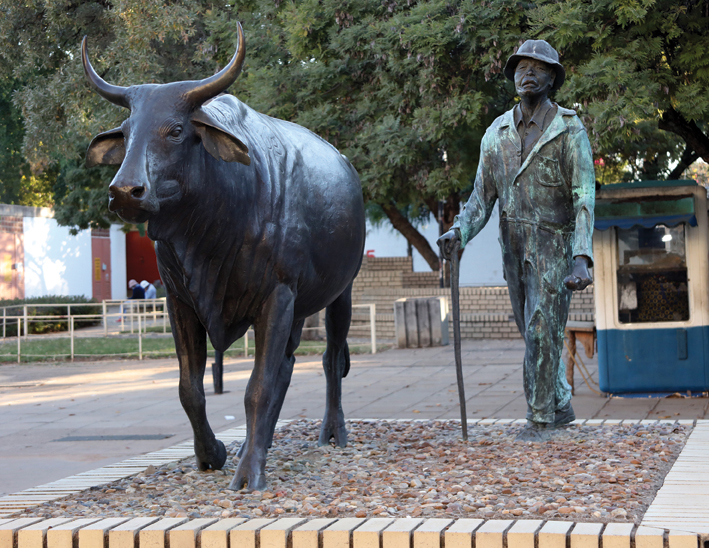
The statue of a modisa or herd-boy holding a walking stick and a knobkerrie, driving an ox that stands proud in front of the UB library remains a testimony for the coming generations, to Batswana’s spirit of self-reliance, which unfortunately is beginning to wane.
It is also worth noting that the spirit of self-reliance in education was carried forth into the running of government, as Botswana decided to avail free universal education to its citizenry to create the requisite human resource to run the country, which has hitherto led to Botswana being touted as shining example of not only free universal education, but prudent use of national resources.
In an interview with BOPA, University of Botswana History Professor, Part Mgadla stated that Sir Seretse Khama was a visionary and charismatic leader, who could eloquently appeal to the nation.
He said Sir Seretse Khama was a true proponent of self-reliance, adding however, that such sacrifice was not new in the history of Botswana because some educational and health centres were built through self-help efforts in the past.
“As you might be aware, the concept of self-reliance is a prominent feature of many post-independence African governments and here at home, regimental systems or ‘mephato’ used to be dispatched to build dams and roads, which was a voluntary thing that eventually benefitted the entire society or nation at that time.” he said
Prof. Mgadla said Sir Seretse Khama’s Botswana University Campus Appeal (BUCA) was coordinated by one, Potlako Molefhe, who ensured that rudimentary structures were in place to absorb the next batch of students that were initially destined for Roma Campus in Lesotho.
“The first President in particular was committed to the course and was able to use the idea of self-reliance in higher education as a strategy for development and nation building and the university became a symbol around which the nation rallied irrespective of one’s social standing,” he said.
He stated that indeed what Sir Seretse Khama envisioned became a success story as many of the graduates of the UB have gone on to play a critical role in localising the country’s human resources and some even becoming politicians of note.
Prof Mgadla further reminisces that when UB was eventually established, it was charged with the responsibility of improving and expanding the quality of the human resource that was so much needed for the development of the nation.
“To me the university has lived up to standards because, before there was no graduate school and people went overseas to pursue their doctorates, but now it offers a wide array of courses to Batswana and the region at large,” he said.
He said the university also has a good reputation, qualified personnel and continues to make an impact in southern Africa as it has students from other countries pursuing both undergraduate and graduate programmes.
He said in the 80s, there were only faculties of humanities, social sciences, science and education with agriculture being part of the Botswana College of Agriculture in Sebele.
Prof. Mgadla said with time came a lot of changes, with other faculties like medicine, health sciences, psychology and physical education being introduced, and now graduates only go overseas for specialisation.
According to UB archives, from a humble enrolment of only 1 095 students in 1982, and a handful of mostly expatriate staff members, UB now boasts a student population of about 15 000, with a capacity of up to 20 000.
The University of Botswana now has a staff compliment of about 3 000, most of whom have been trained up to doctorate level, having cut their teeth in tertiary education at the UB. It now has branches in the North West District, being the Okavango Research Institute (ORI) in Maun and a Centre for Continuing Education North (CCE, North) in Francistown.
The Centre in Maun does research on the wetlands and finds ways of preserving the Okavango Delta and has immensely contributed to the listing of the Okavango Delta as UNESCO’s 1000 World Heritage site. Ends
Source : BOPA
Author : Mmoniemang Motsamai
Location : Mochudi
Event : Interview
Date : 29 Jun 2021
Related News
08 Aug 2026

07 Aug 2026
Xiplomacy Hosting the world building the future
07 Aug 2026