


A great statesman that Seretse was
29 Jun 2021
Walking a hitherto uncharted terrain as president of a newly and very poor independent Botswana, Sir Seretse Khama woul not allow the fact that his new administartion was broke to dampen his spirits or those of the new nation. Instead, through consultation and determination he turned the direction of the country, altering its course towards success.
“When my government took office in 1965 we were faced with a problem of underdevelopment of classis proportions, no attempt to educate Batswana to run their country…no provision of vocational training, road, water supplies, industrial development inadequate….we are now tackling these problems.
It is to praise the effort of my people,” he said in his address to the 6th Ordinary Session of the Assembly of Heads of State and government of the Organisation of African Unity (OAU) in 1979.
This positive approach to overcome the challenges was informed by a set of guiding principles built around four themes of unity, democracy, development and self-reliance.
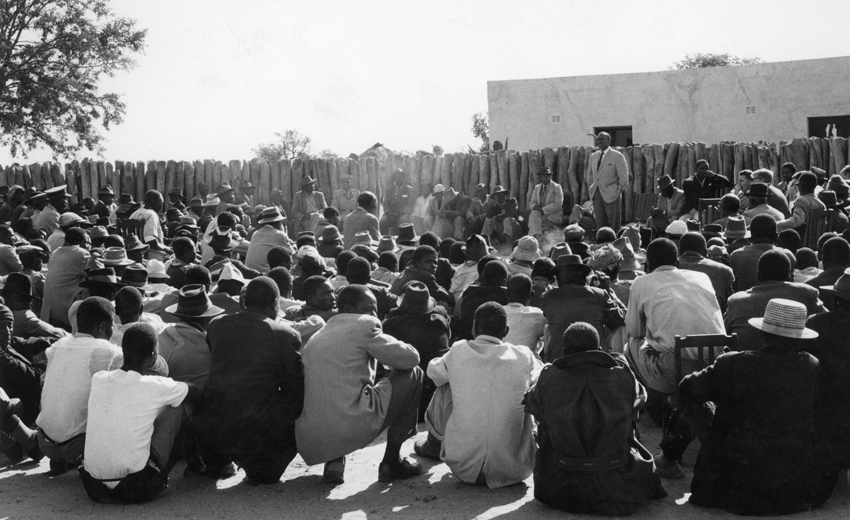
“Being one of the impoverished nations at independence, development was a key factor for President Seretse Khama to achieve. His party, the BDP had an elaborate policy document [called] ‘Therisano’ which espoused participatory democracy in terms of the Kgotla system.
They used the arrangement to drive the national development plans,” said Head of Department at the University of Botswana’s History department Dr Boga Manatsha in an interview.
Dr Manatsha said Sir Seretse Khama as part of the BDP collective was for non-racialism, something he said won him admiration from many quarters especially in the midst of the turmoil in Southern Africa where white minorities ruled.
That also earned him the ire of the minority leaders, but he would not relent in his pursuit of non-racialism so much so that by the end of the 1960s relatively newly independent Botswana was recognised as a model of non-racial democracy within an area of racial hatred and tension.
“His non-racism stance caught the eye of the international community, Botswana was thus seen as a country that needed to be assisted as it was surrounded by hostile regimes. When the late Sir Seretse Khama took power, issues of self-reliance came to the fore. Botswana had to self-sustain as the British had left them an impoverished nation, and President Khama stood up and put up some development plans and initiatives that were to be implemented,” he said.
Dr Manatsha said Sir Seretse Khama laid a foundation for ideals that must be supported and that Botswana’s leaders must try to diversify the laid foundation and engage.
However he noted, “Botswana is still a well-functioning democracy despite some matters of the Constitution here and there which needs to be reviewed following a consultative process,”
From the beginning of his leadership Sir Seretse Khama emphasised the importance of democracy and the involvement of people in decision making. He emphasised self-reliance as the only basis on which economic independence could be built.
Sir Seretse believd in a government that prioritised service to its people.
“Our first duty will always be towards the people of this country”, he said at the First meeting of the First session of the First Parliament on October 6, 1966.
He also believed in national integration and unity of the nation..
“Botswana will progress from a collection of tribes with local loyalties and aims to a nation state with a common national pride and common national interest,” he said in his speech to the National Assembly.
Thus Sir Seretse Khama through his system of government brought together different ethnic groups into one peaceful nation. That legacy remains.
Loved by his people Sir Seretse Khama remained President, having easily sailed through two terms until his death on July 13 1980.
Today, his bronze statue stands proudly on Parliament’s grounds at Gaborone’s Government Enclave, proudly regarding the old Central Business District. Ends
Source : BOPA
Author : Baleseng Batlotleng
Location : Ramotswa
Event : Sir Seretse Khama Centenary celebration
Date : 29 Jun 2021
Related News
08 Aug 2026

07 Aug 2026
Xiplomacy Hosting the world building the future
07 Aug 2026