AoJ to establish specialised courts for GBV
01 Nov 2020
The increasing cases of Gender-Based Violence (GBV) have compelled the Administration of Justice to establish specialised courts at the magistrates level to specifically try such cases.
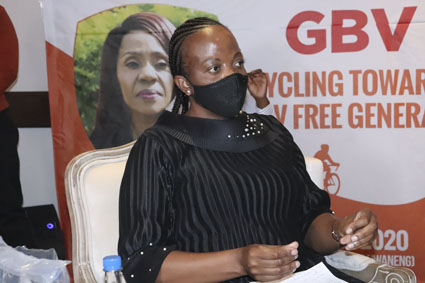
This is according to the deputy registrar of the High Court, Ms Nomsa Moatswi, who was speaking at a round table discussion that succeeded a GBV cycle challenge campaign by First Lady Ms Neo Masisi in Jwaneng on October 31.
Such cases include rape, defilement, incest and assault.
Ms Moatswi, however, said the process was still on the table and would start at places where such cases were high when it finally rolls out.
“We have so far noted that in the southern part of the country, Molepolole and Kanye lead in cases related to GBV while Serowe and Francistown are on the lead in the northern part.
So these are the places that were are likely to start with when the specialised courts are finally rolled out,” she said.
She said the Administration of Justice would be working in conjunction with the Department of Public Prosecutions as well as the police on such matters, and that the proposal was to use mobile courts for proximity with witnesses as well as cut the litigation costs.
Ms Moatswi said the Chief Justice was expected to soon declare GBV cases as urgent matters to enable them to be tried faster as it had been noted that delays posed challenges such as the death of primary witnesses or witnesses even forgetting vital details, thereby leading to loss of cases.
She also said that as a department, they were concerned by the withdrawal of GBV cases by victims on the pretext that they had reconciled with the offenders.
“This does not always prove to be true because there are many instances where perpetrators carry out their threats even after a claim of reconciliation is made,” she said.
She urged parents and guardians to desist from withdrawing cases committed against children and said that they had also noted that some cases were withdrawn because offenders had paid victims.
Earlier on, one of the attendants, Ms Sheila Mlazie had complained of delays in trying GBV cases, which she said compromised evidence.
She also welcomed the proposed Sex Offenders Registration Bill as she said it would help identify potential ‘pests’ in the society.
Ms Mlazie also proposed specialised courts where children could give evidence without being face to face with their abusers.
For her part, the National Children’s Council chairperson, Ms Mamiki Kamanakao said Botswana had ratified the 1989 UNICEF Convention on Rights of Children, meaning that the state was empowered to refuse any intent by a parent to withdraw a case committed against a child.’
“This is the very legislative that is often used when some people refuse their children to be vaccinated.
The legislation gives the state the right of a parent,” she said.
Ms Kamanakao also raised a concern at the rate at which men accused of impregnating children often go free once DNA evidence proved that they were not the fathers, saying such only addressed the issue of pregnancy and not the fact that sexual intercourse with a minor took place.
She then called for a need to work with the police as ‘friends of the court’ to give evidence in such cases. ENDS
Source : BOPA
Author : Olekantse Sennamose
Location : JWANENG
Event : round table discussion
Date : 01 Nov 2020
Related News
10 Aug 2026
10 Aug 2026
MoU to drive innovation and investment
10 Aug 2026
First Lady urges support for teenage mothers
10 Aug 2026
Gaolathe hails partnership for HIV response

10 Aug 2026