Worker employer communication important
01 Jul 2020
A Labour Inspection Unit officer has emphasised the importance of open communication between employers and employees.
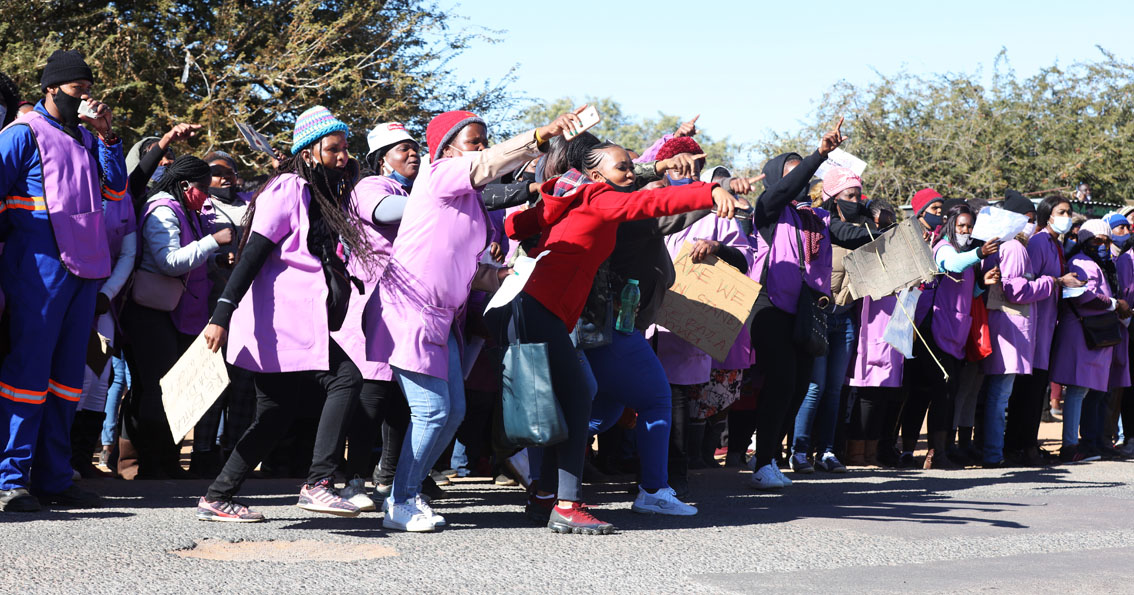
Addressing Kromberg and Schubert employees, who had downed tools due to ‘unfair labour practices’ on Monday morning, Mr Tshenolo Ratshosa said when an emergency situation arose, as with COVID-19, the two contracted parties should find a mutually beneficial solution.
Mr Ratshosa said as the two parties had an agreement on how they would work together at the beginning of the term, the same should happen when one wished to make changes to the agreement.
He urged employers to engage employees in every decision that might affect their work, both directly or indirectly, adding that if a decision is taken without the other party, the initial agreement stands.
He said the Labour Act binds both the employer and employee to communicate and for one party to ensure that the other is on board.
Mr Ratshosa explained that where there had been no mutual agreement between the employer and employees, the employer should pay workers, as long as they did their part - worked for the company.
He said employees had the right to open a case of failure to pay wages at the labour office, which would mediate and try to rectify the problem, failing which the case would be taken to the Industrial Court.
He told the workers that despite their frustrations of allegedly not being paid, failure to follow the labour procedures could slow the officials’ process of tackling the issue.
He also warned them that as part of the State of Emergency regulations, employees were not allowed to strike, likewise employers are not allowed to fire or withhold workers’ monthly wages. Botswana Federation of Public, Private and Parastatal Sector Unions, assistant secretary, Mr Ketlhalefile Motshegwa advised the workers to form a union, which will hasten to attend to their issues.
He said employers should not use the pandemic as an excuse to not pay workers, regretting that some companies took the wage subsidy from the government, but did not pay their employees.
“We are working on finding all the companies that got assistance from the government, but did not pay their workers,” he said.
Mr Motshegwa said an employer should not force, but negotiate with workers to take leave days when the company was in crisis, as the employee had the right to either refuse or agree to take the leave days.
Kromberg and Schubert workers’ representative, Mr Tumisang Sekete took issue with the mode of communication the employer used to address them, saying a notice board in not appropriate for issues of retrenchment, cutting of wages and working days.
He said the company does not believe that workers should voice their frustrations to management, which makes decisions alone.
“The lowest paid employee’s basic salary is P1 800. This month end some got salaries ranging from P68 - P470, which is not even half salary,” he said.
Mr Sekete said as the COVID-19 pandemic took everyone by surprise, management had told them that they would work for only 12 days in a month, to their surprise they were now told to work once or twice in a month and everyone got paid only for the time they worked.
This, he said was against the agreements they had, both the initial employee agreement and the 12 days COVID-19 agreement.
“We have been quiet for a very long time. This treatment is not starting with COVID-19,” he said.
He said the working environment is not good for their health, alleging that some expectant workers have had miscarriages, but management has not heeded their cry.
Mr Sekete said employees did not get paid risk allowances or compensation, citing a case where an employer lost their fingers, while operating a machine. Naledi North councillor, Mr Oarabile Motlaleng appealed to workers to register their cases for them to be solved quickly. Ends
Source : BOPA
Author : Oarabile Molosi
Location : Gaborone
Event : Address
Date : 01 Jul 2020
Related News

11 Aug 2026
Boko calls for radical reforms in public service
11 Aug 2026
Botswana and US commit to global peace

11 Aug 2026
Chobe district receives malaria drugs
11 Aug 2026