BIH hand water treatment plant
05 May 2019
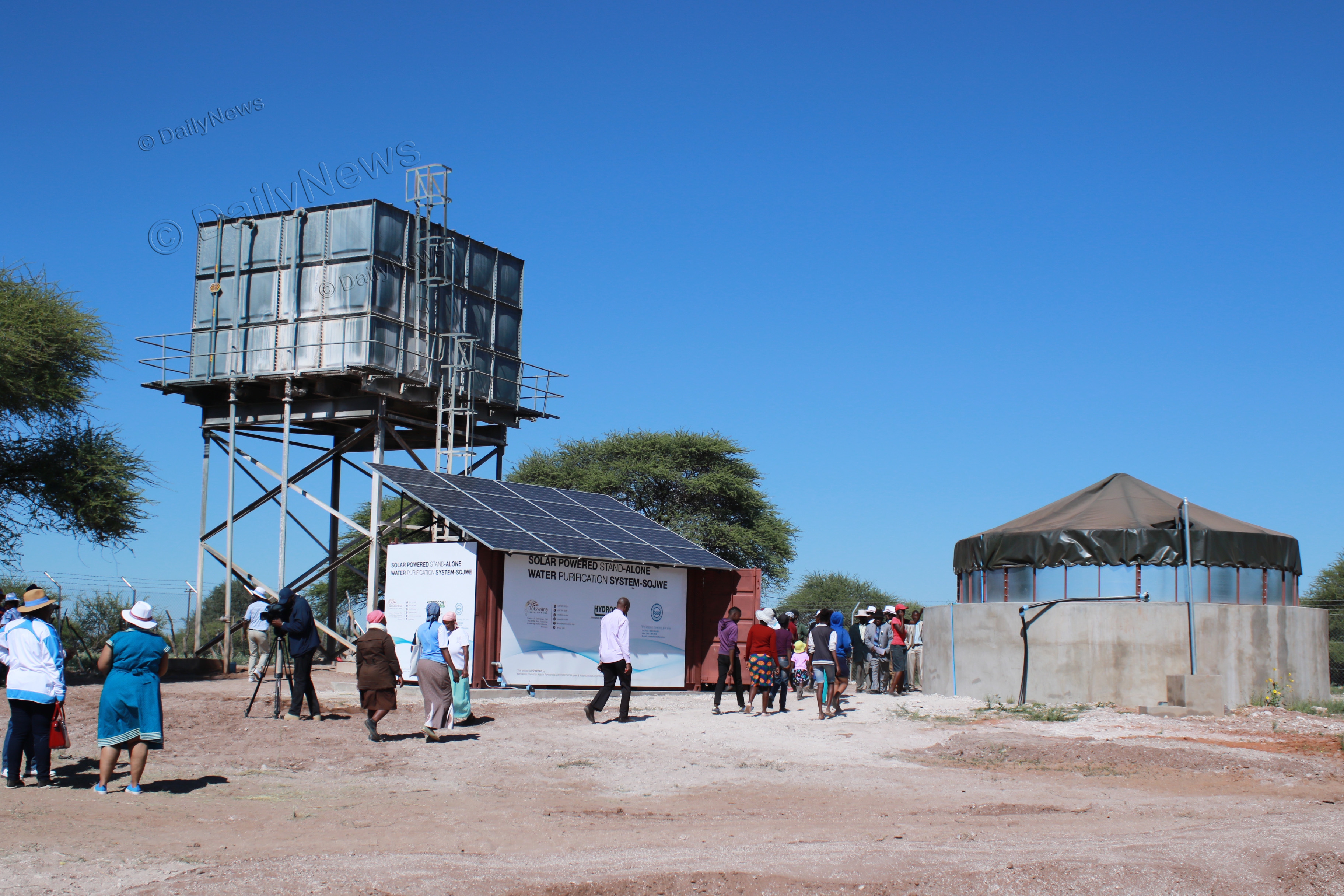
Botswana Innovation Hub (BIH) in partnership with Hydrocon Green and Water Utilities Corporation launched a solar powered water treatment plant in Sojwe to create a sustainable clean and purified water supply to the community.
Speaking at the handover ceremony on May 3, BIH board member, Mr Midas Sekgabo said he was optimistic that the 12-month pilot water treatment technology would improve water quality in the village and surrounding areas.
Mr Sekgabo explained that BIH worked through its stakeholder base and partnerships to identify challenges and provide solutions to effectively deliver working prototypes where needs were identified.
He said their mandate allowed them to undertake key pilot projects with potential to grow and deliver services nationally.
One of their key values, he said, was excellence in the delivery of services, hence the water treatment plant was a perfect demonstration of living the value.
Mr Sekgabo stated that BIH started the development of the water treatment unit in partnership with Hydrocon-Green company, who were the technical partners responsible for the design and fabrication of the plant, while WUC had the mandate to supply potable water to communities.
He stated that WUC identified a need for technology that would bring the water quality in the village to potable standards.
Following the success of the pilot project, he said they desired to develop a viable business model for the commercialisation of the current prototype to be availed to areas with similar water problems locally and internationally.
“This way, we will become sustainable in delivering our local solutions as a country,” he said.
Mr Sekgabo also indicated that BIH would continue working with Hydrocon Green to further test the unit with WUC observing the water quality to ensure it was of the right quality for household use.
Water Utilities Sustainability and Water Resources director, Mr Gaselemogwe Senai appreciated BIH leadership for financing the water treatment plant expected to address challenges of water shortage in Sojwe and Boatlaname.
He said the two villages used to have separate water supply schemes.
Sojwe was supplied from two boreholes, which were decommissioned in 2006 due to high levels of nitrates.
One borhehole that was supplying Boatlaname was also decommissioned because of the same problem.
Mr Senai further explained that following the challenges, the Sojwe and Boatlaname schemes were interconnected and supplied from a separate borehole, which was highly dependent on annual rainfall.
As a result, he said its production fluctuated between seasons depending on the amount of rainfall received.
In 2016/17, the borehole’s capacity declined in yield from 27 to nine cubic per hour.
Mr Senai stated that when at its lowest the borehole’s yield could not meet water demand for the two villages.
Given the situation, he said ‘this leaves the corporation with no option, but to augment water supply by bowsing, which is costly and has its own operational challenges.”
He stated that the dire situation was worsened by the intermittent breakdown of the borehole operation leaving the villages with completely no source of supply at times.
He said though the corporation resorted to bowsing, it was not enough since the corporation still could not meet the water demand for the area.
Mr Senai highlighted some of the challenges that caused water shortages in the country, saying most parts of the country, about 60 per cent drank from boreholes and only 40 per cent from dams.
As a result, a lot of boreholes dry up, some sink, while some produce water that has a lot of lime and in areas such as Ramotswa and Macheng most boreholes have nitrates, making the water not fit for drinking.
Therefore, he said BIH’s gesture could not have come at a more appropriate time.
With the provision of the plant he said WUC was able to re-commission the old borehole in Sojwe back to operation.
It is envisaged that the plant will be able to treat the nitrate in the water and put the borehole to good use, augmenting supply and improving reliability and security of supply to the villages.
The project consists of a nitrate removal plant and evaporation ponds at a cost of P700 000 which was fully financed by BIH while WUC provided a 1.3 kilometre pipeline, fence, guardroom, ablution facilities and other works at a cost of P250 000.
This brings the total cost of the project to about P1 million.
He urged residents of Sojwe and Boatlaname to save water and make water conservation a lifestyle.
Hydrocon-Green representative, Mr Luke Richards however, explained that the technology behind the plant was not complicated.
He said the plant used renewable energy in the form of solar power to pump water from the old borehole that has nitrates into the system.
The water is then cleaned and residue in the form of salt and nitrates is removed and stored in separate equipment.
The water is then softened and treated further with chlorine.
The water then gets pumped up in the reservoir tank that feeds the village and is blended with potable water from the borehole that has been supplying the village, then it is distributed to the two villages.
Kgosi Tlhabologang Hube appreciated efforts made by the three entities, saying that residents would never experience water shortage again.
He also appreciated the gesture from the government, saying that it demonstrated that communities in rural areas were not forgotten and that his people would stop complaining of illnesses resulting from drinking from polluted sources of water. ENDS
Source : BOPA
Author : Lindi Morwaeng
Location : SOJWE
Event : Handover Ceremony
Date : 05 May 2019
Related News

15 Aug 2026
15 Aug 2026