

De Beers 2019 outlook positive
24 Feb 2019
The De Beers Group of Companies says optimistic consumer sentiment and investment in marketing have contributed to positive global consumer demand for diamonds in 2019.
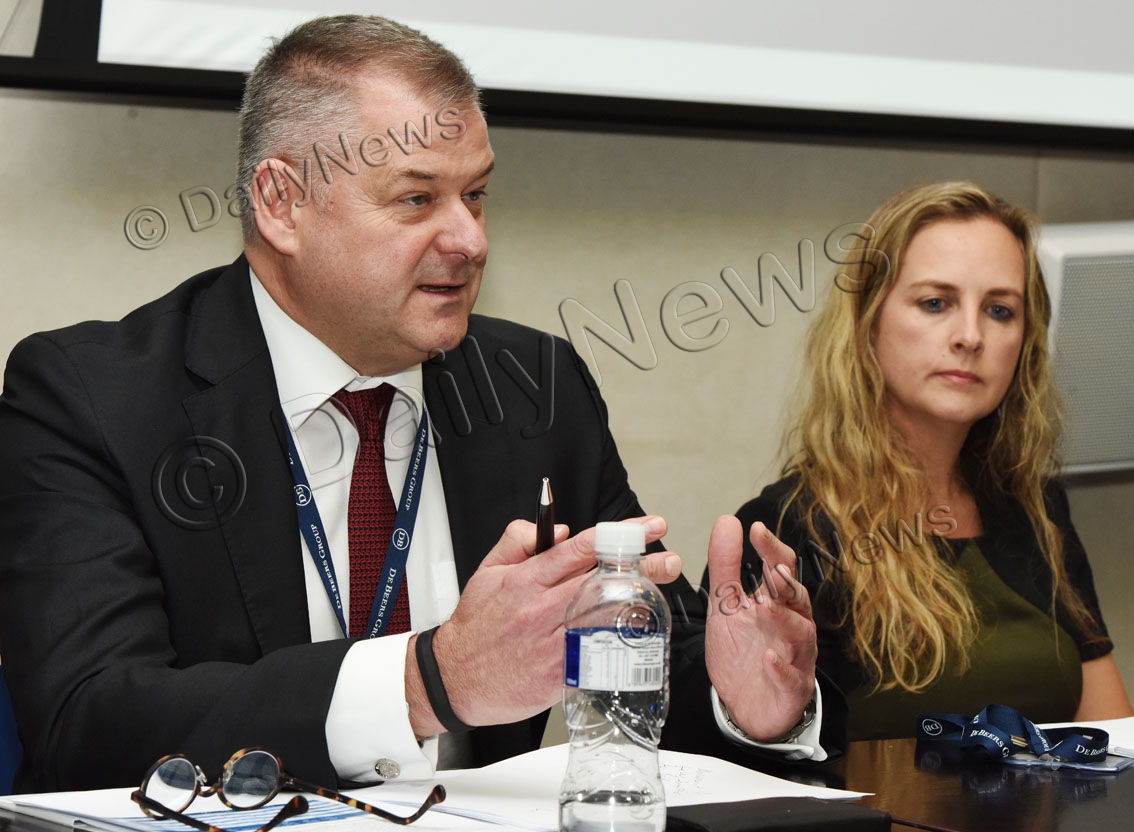
However, Diamond Trading Botswana executive vice president, Mr Paul Rowley told a media roundtable recently that there remained several potential headwinds, including macro-economic instability and exchange rate volatility.
Speaking on the group’s preliminary financial results for 2018, he said despite a number of headwinds, total revenue increased by four per cent to US$6.1 billion with rough diamond sales increasing by three per cent to US$5.4 billion.
“Preliminary data for 2018 indicates an improvement in global consumer demand for diamond jewellery in US dollar terms,” he said, adding that there was strong consumer demand for diamond jewellery driven by growth in the US and China.
Mr Rowley said other revenue also increased owing to improved ‘high end’ jewellery sales at De Beers Jewellers.
He said while unit costs and upstream profit margins were maintained, De Beers undertook incremental expenditure on a number of new initiatives, including the launch of Lightbox Jewelry as well as in marketing, exploration and evaluation in Canada.
During the first half of the year, he said global growth was driven by solid US and Chinese consumer demand, but that in the second half while the US maintained its growth rate, increased political and policy uncertainly and stock exchange vitality led to a slowdown of demand.
Mr Rowley said the year started on a positive note due to healthy demand for polished diamonds from US and Chinese retailers, but that in the second half, the low-priced product segment came under pressure due to weak demand and surplus availability, the rapid depreciation of the Rupee and a reduction in bank financing.
That, he said, resulted in a surplus of low-priced polished diamonds at the end of the year, leading to lower sales at the start of 2019.
Regarding operational performance, he said rough diamond production increased by six per cent to 35.3 million carats while in 2017 it was at 33.5 million carats.
He said in Botswana production increased by six per cent to 24.1 million carats compared to 22.7 million carats in 2017.
Mr Rowley said production at Jwaneng was flat as the effect of processing planned lower grades was offset by a 12 per cent increase in plant throughput.
At Orapa, a 13 per cent increase in output was driven by higher plant utilisation and the full effect of the successful restart of the Damtshaa operation, he said.
With regard to neighbouring countries, Mr Rowley said in Namibia production increased by 11 per cent to 2.0 million carats from 1.8 million carats in 2017 while South Africa registered a 10 per cent decrease and Canada a 19 per cent increase.
Regarding brands, he said De Beers Jewellers opened new stores in Hong Kong and China and launched new franchise partnerships in Russia and Saudi Arabia.
De Beers Jewellers also launched a new online store in partnership with Frafetch, a global market place for the luxury industry with a presence in 100 countries.
He said Forevermark was now available in more than 24 000 retail outlets globally with its first stand alone store opened in Botswana.
For her part, the company’s corporate affairs and government relations vice president Ms Pat Dambe said a number of initiatives were running in Botswana among them the Stanford Partnership, a US$3 million three-year partnership with the Stanford Graduate School of Business to empower young, aspiring entrepreneurs and business owners in Botswana, Namibia and South Africa.
She said there were collaborations with the Ministry of Tertiary Education where Botswana participants represented a range of industries and geographical locations across the country with nearly half of the companies involved coming from outside Gaborone.
Another initiative, she said, was aimed at supporting jewellery designers from all De Beers producing countries; Botswana, Namibia, South Africa and Canada.
Ms Dambe also talked about the remodeling of the jewellery competition into a skills development contest, saying in 2017 the re-modelled structure was reviewed and adopted with the aim of developing all countries in the jewellery design industry.
She said the programme now had three positions of winner, first and second runners-up for each country. ENDS
Source : BOPA
Author : Lesedi Thatayamodimo
Location : Gaborone
Event : Press Brief
Date : 24 Feb 2019
Related News
29 Jul 2026
29 Jul 2026
Poultry industry attains self-sufficiency
28 Jul 2026
Ross Breeders pioneers Botswana poultry exports

28 Jul 2026
Value chain key to industrial growth - Ntsima

28 Jul 2026
Africa SME body honours Boko
28 Jul 2026