


Poverty eradication possible
20 Mar 2018
The shift by government from the notion of reducing poverty to that of eradicating it was in recognition of the fact that poverty eradication was indeed attainable.
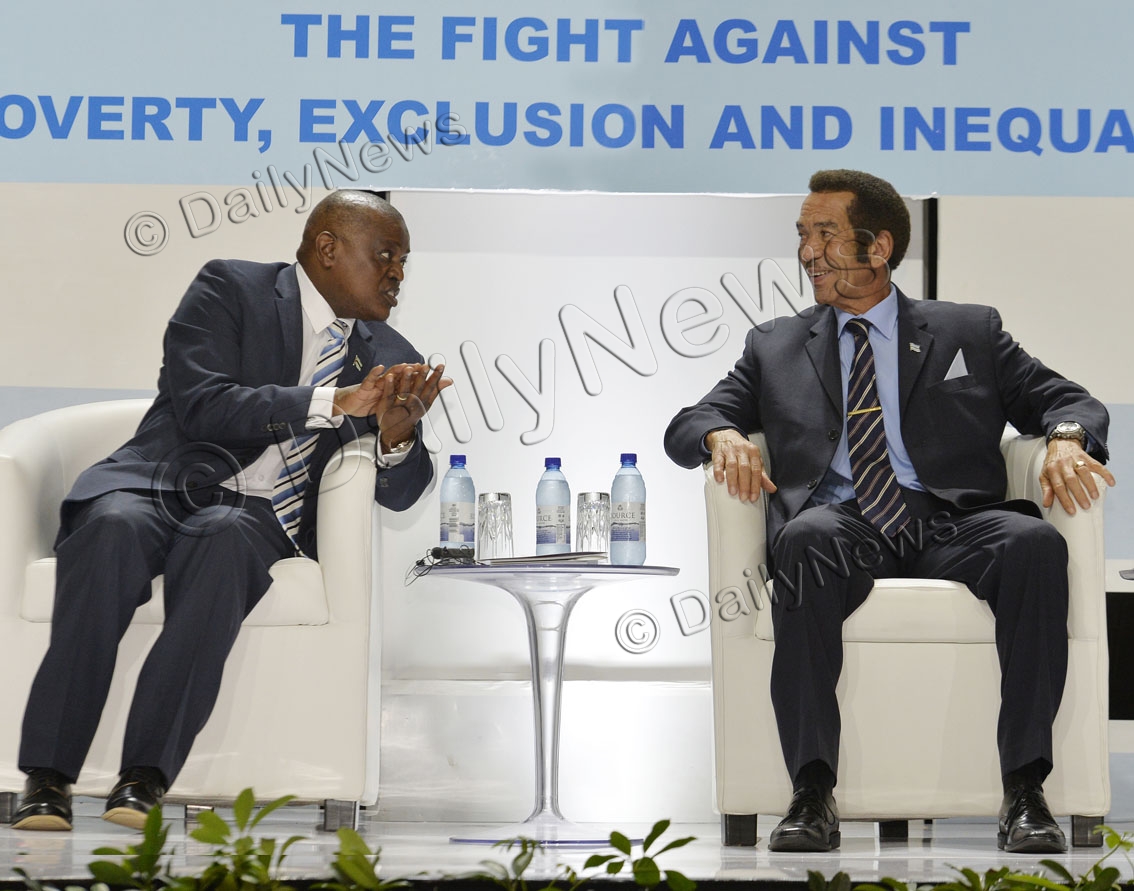
Officiating at the international conference on poverty eradication on Tuesday, President Lt Gen. Dr Seretse Khama Ian Khama said in recognition of this, a commitment had been made that one of government’s priorities be to eradicate poverty with a view to ensuring that every citizen enjoyed a dignified life.
“It is worth noting that only nations that provide for all their citizens to enjoy dignified livelihoods can fit the description of being truly prosperous as the existence of people vulnerable to impoverished conditions means that the entire nations are affected,” he said.
He said the need to achieve this feat in Botswana had consequently necessitated the policy shift in 2009 from poverty alleviation to eradication; adding that the intention was to take Batswana out of poverty, strengthen and increase the scope of the poverty eradication programmes as well as that of social safety net programmes.
“Amongst the changes in terms of focus, which are clearly articulated in our current National Development Plan, is recognition of the need for greater effort to secure a pattern of economic growth that is more inclusive with a corresponding reduction in inequalities,” he said.
President Khama expressed contentment on the progress that had been made following the policy shift, hailing the several initiatives that had since been adopted for having contributed significantly to assisting Batswana to break the poverty cycle.
He said results from surveys conducted by Statistics Botswana attested to this, as they showed that the proportion of people living below the poverty datum line had continued to decline over the years.
Lt Gen. Dr Khama on the one hand expressed concern that the global picture of people living in poverty, particularly in developing countries, was to date still discouraging.
“The latest statistics from the 2016 World Bank report indicates that more than 700 million people or 10 per cent of the world’s population still live in extreme poverty,” he said, lamenting further that the majority of those were children.
He said it was disheartening that whilst other regions such as South and East Asia as well as the Pacific were making notable achievements in the fight against poverty, Sub Saharan Africa was still lagging behind.
President Khama said it was however gratifying that the international community, through the framework of the Sustainable Development Goals (SDGs), had placed poverty eradication at the centre of the sustainable development agenda, a noble cause that he pointed out would undoubtedly contribute immensely to humanity.
“Similarly, the African Union, through Agenda 2063 has also committed member states to eradicate poverty in one generation while building shared prosperity through social and economic transformation,” he added.
Speaking at the same event, Minister for Presidential Affairs, Governance and Public Administration Mr Eric Molale noted that the attitude that there would always be poverty, or that poverty could never be eradicated was no longer acceptable.
He said it was in realisation that the war against poverty could be won that government had responded positively towards poverty eradication through the various initiatives and programmes that had since been adopted.
Minister Molale said the need for inclusive approach to tackling poverty was in fact rooted in the nation’s founding principles of democracy, development, self-reliance and unity as well as that of botho.
He pointed out that over the years, these higher national principles had been cascaded into the country’s principles of planning which were based on the need to promote social harmony through a sustainable development path that achieved rapid growth and economic independence while ensuring social justice.
The minister noted that it was on the basis of these overarching principles that government had come up with various policies, programmes and initiatives to address poverty, citing ISPAAD, LIMID, youth empowerment scheme, women empowerment programme and the poverty eradication programme as some such initiatives.
“In addition, the provision of relatively free education and health care services, food at schools, programmes for orphans and destitute persons, have also made a positive contribution to uplifting the lives of Batswana,” he observed.
Mr Molale also concurred that Botswana had indeed made progress towards eradicating extreme poverty as evidenced by the declining percentage of people living under the poverty datum line, adding further that government had taken a position that there were no tolerable levels of poverty.
For his part, a research fellow at the University of Sussex Mr Stephen Devereux said poverty manifested itself in many forms such as hunger and the deprivation of basic things such as health and education.
Mr Devereux said it was disappointing that while other continents had made progress on addressing the varying manifestations of poverty, results in Africa were still far less satisfying particularly with regard to hunger.
To change, the plight of the world’s poor, he said it was critical that social exclusion and marginalisation be reduced.
In addition to the need for the transfer of productive assets to the poor and the vulnerable, he said it was also crucial that their resilience be strengthen through various mechanisms.
Mr Devereux also highlighted the importance of empowering women, a move that he said would add significant impetus to the efforts to reverse the impact of poverty.
Giving an overview of the conference UN resident representative Ms Jacinta Barrins said it provided a platform for the review of the various poverty eradication initiatives being implemented in different countries.
In addition to discussing the methodologies of assessing poverty, the instruments as well as tools for measuring poverty, Ms Barrins added that the conference was an opportunity for countries to share experiences on the challenges facing poverty eradication efforts as well as coming up with solutions thereto.
The two-day conference will also feature panel discussions on how countries have continued to tackle poverty, lessons and best practices that had been learnt from the efforts to end poverty, as well as devise strategies aimed at reducing inequalities and enhancing inclusion. Ends
Source : BOPA
Author : Keonee Kealeboga
Location : Gaborone
Event : Conference
Date : 20 Mar 2018
Related News

21 Aug 2026

20 Aug 2026
Botswana Donates FMD Vaccines To Lesotho
20 Aug 2026
Atamelang new transport minister
20 Aug 2026