

Letlhakeng village that sits on a serpent
30 Jan 2018
The first issue that strikes first-time visitors to Letlhakeng is its stunning landscape. A valley cuts through it like a great serpent and almost divides it into two, offering a magnificent bird view on either side, especially when one stands on the far west.
However, first impressions can deceive. Despite all the good looks, Letlhakeng can be considered a typical example of the saying “O se bone tholo borethe, teng ga yone go a baba”.
Like all other villages in the country, residents of this village wish for developments to come their way, but in the case of Letlhakeng, nature seems to be the biggest constraint frustrating the wishes of the villagers.
Such constraints include the two broad river valleys of Moshaweng and Gaotlhobogwe that cross the build-up and future expansion areas of the village.
However, these two pale in comparison with perhaps the biggest physical challenge of them all; that of unpredictable collapsible soils.
For many years the development of the village has been hampered by a phenomenon that causes houses to develop significant cracks, which in extreme cases forces the whole buildings to be abandoned.
Local legend has it that there is a large serpent underneath the village that causes the cracks as it moves around. One local, Ms Bontekanye Dimeku indicated that indeed they have heard about the legend of the snake ever since their youth.
“We used to see cracks and collapsed buildings around the village and told that the snake is moving around underneath. Some elders told us that the snake was not happy that the village has been founded on its territory,” she said.
However, now equipped with the advantage of wisdom that comes with age, Ms Dimeku now reckons the tale might not be entirely true.
“Batswana have a way of finding simple explanations for complex phenomena. When something occurs that they don’t understand, they try and find a simple context to fit it in and that must be the same with the legend of the snake because no one has ever admitted having seen it, not even once,” she said.
Scientifically the explanation justifies Ms Dimeku suspicions. According to a geotechnical and hydrological investigations report commissioned by the Department of Town and Regional Planning in 2006, the cause of such cracks is the fact that the village sits on collapsible silt sand.
The investigation, which was done by Geotechnics International Botswana in collaboration with CPP Botswana, indicates that such soils cover 84 per cent of the village, and that the nature of the soil posed a serious threat to foundations of structures, especially double storey buildings, if appropriate pre-construction measures were not taken.
The report also indicated that such a threat was exacerbated by the fact that the soils were susceptible to wetting and thereby loosening its fabric leading to sudden settlement which often results in damages to buildings in the form of cracking.
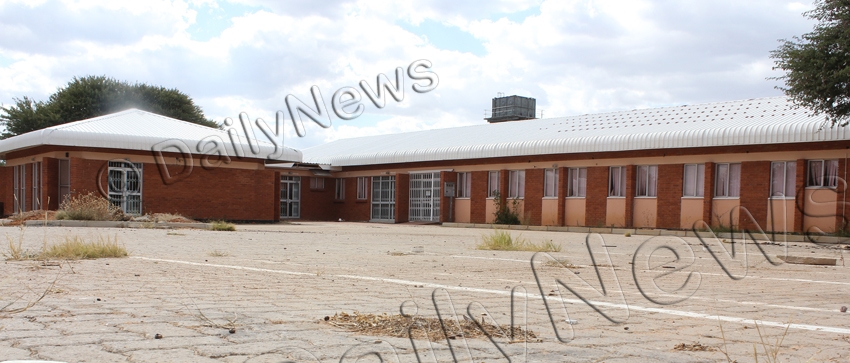
Across the village several large buildings have been abandoned as a result of this phenomenon, among them a whole junior secondary school. The site, now only known as Old Mphuthe, was wholly abandoned and a completely new junior school was built from scratch on the more ‘friendly’ side of the village.
Today the old site still lies abandoned, safe for the students’ hostel although it is also expected to be vacated soon as new hostels are being constructed at the New Mphuthe.
The village’s tribal administration offices have also been abandoned, with the village’s tribal leaders seeking shelter at the Rural Administration Centre.
Meanwhile the centre has also not been spared the crackings as some offices are showing signs of giving in.
Last year, the Letlhakeng Sub Land board was forced to abandon office and seek refuge at a private complex as the landboard structure was threatening to collapse due to severe cracking.
Currently the Food Relief Services depot is also under strain although it is still in use, and the roads in the area have also not been spared as some sections, especially the stretch to Ditshegwane has also developed some deformations because of the collapsible soils phenomena.
The report has recommended that some pre-construction measures be taken in order to minimise damage to buildings in collapsible soils, and one such recommendation was excavating the soils and building a conventional reinforced concrete strip footing.
Another alternative was to dig up the collapsible soils and replace it with suitable imported ones. The report also recommended that such removal of the collapsible soils could also be done beyond the perimetre of the building to be constructed.
Additionally, the report recommended to the detail, the frequency at which levels of brickwork should be reinforced, type of cement and couplings to be used as well as constructing roof downpipes to discharge water away from buildings to prevent ponding at the edge of foundations.
However, it should be noted that such were recommendations meant to only minimise the cracking. While remedy for the cure of the cracking was yet to be found, residents would continue to hold the great serpent that lies beneath their feet at fault, and believe that until it is somehow appeased, it would continue to frustrate any efforts to bring developments to their village. Ends
Source : BOPA
Author : Olekantse Sennamose
Location : LETLHAKENG
Event : Interviews
Date : 30 Jan 2018
Related News
03 Jun 2026
03 Jun 2026
Hunyepa engages Tati West schools on challenges

03 Jun 2026
Kgatleng Ramps up Preparedness For Ebola

03 Jun 2026
Boko Praises Belgium Ties

03 Jun 2026