



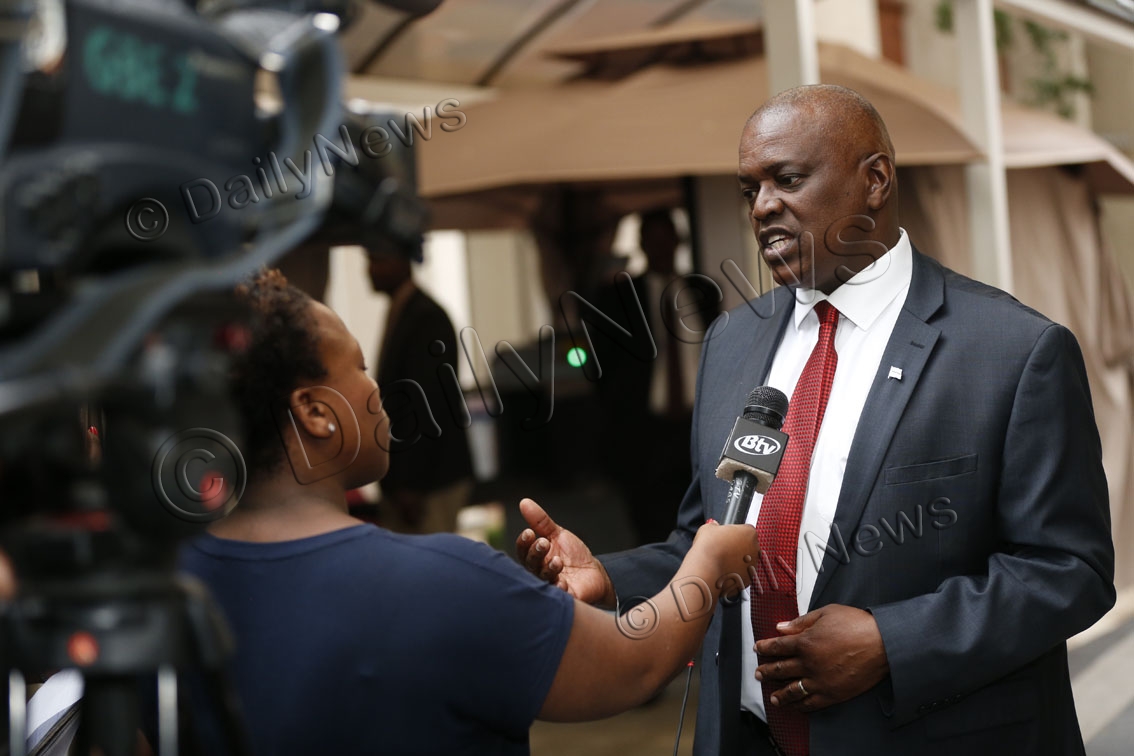
Vice President concludes SONA debate
05 Dec 2017
Despite having been one of the poorest countries in the world at the time of attaining independence, Botswana has over the years made great strides in terms of development and general economic growth.
In a response that brought the debate on the State Of the Nation Address (SONA) to its conclusive end on December 4, the Vice President, Mr Mokgweetsi Masisi noted that the country had since moved from a predominantly agricultural economy that was characterised by scarcity of water, lack of social amenities and very little infrastructure to one with an impressive record that had been built on the discovery of diamonds, but leveraged on prudent fiscal policies, international financial and technical assistance and a pragmatic foreign policy.
The vice president, who is also the Moshupa-Manyana MP, indicated that the country had, in recognition of its credible and sound policies, aimed at promoting sustainable economic growth, diversification and employment creation, has been ranked the best investment destination in Africa by the 2016 African Investment Index.
On government’s current efforts, he pointed out that cabinet had in 2008, approved the Botswana Excellence Strategy for Economic Diversification and Sustainable Growth.
“The strategy identifies potential growth areas for development and employment creation.
It gives us an opportunity to fully exploit and harness growth in the mining, agriculture and tourism sectors,” he explained, further, noting that potential in these areas was huge and could as such contribute substantially to the country’s economy and employment creation.
To highlight the effect of the efforts being made, Mr Masisi said the economy had, during the period 2009-2016, grown by an average of 3.9 per cent, and was projected to grow by 5.3 per cent in 2018, a scenario that he said would see it reach its pre-recession limits.
He hastened to indicate that unemployment had declined from 26.2 per cent in 2008, 19.3 in 2013 and 17.6 per cent in 2016.
He added that through strategies such as the Economic Diversification Drive (EDD) and the Economic Stimulus Programme (ESP), the local economy had been stimulated and thus enabled to move out of recession.
On tourism, he said Botswana had over a long period of time, been enjoying increasing international recognition as a premier tourist location. This, he noted, had resulted in the trade, hotels and restaurants as well as transport and communication sectors growing by 13.5 per cent and 5.6 per cent respectively since 2008.
Vice President Masisi added that there were other projects that were being implemented to boost the tourism sector, citing among those the re-fleeting of Air Botswana, implementation of an Integrated Tourism Strategy for the Kasane/Kazungula area and development of airports in Maun and Kasane.
Regarding agriculture, he said that government continued to provide a conducive environment for the growth of the sector since it had the potential to create new business and employment opportunities for Batswana in the rural areas by exploiting the currently under-utilised arable and pastoral land.
He said government was committed to maximising the development of the sector, pointing out that several projects had been identified for implementation, among those being the Zambezi Agro-Commercial Development Project, the Selebi-Phikwe agro-processing plant, irrigation projects for horticulture, fodder and grain production, the Kgalagadi small stock abattoir and the leather industry park.
Mr Masisi said as a result of the efforts that had been made in the past, the country had over the years experienced an improvement in domestic food security as evidenced by the decrease of sorghum deficit by around 80 per cent and that of maize by 10 per cent during the 2016/2017 financial year.
On another matter, he said government aimed to improve the country’s existing infrastructure.
He stated that the projects proposed for implementation in this area included among others land servicing across the country, improvement of broadband connectivity, construction of the Kazungula bridge and the maintenance and refurbishment of government facilities.
This he said was in recognition of the fact that sustainable economic development involved heavy investment in infrastructure that would set the nation on the path to modernisation.
He said government was also developing the Special Economic Zones (SEZ) as a strategy for promoting development of world class industries that are expected to accelerate the diversification of the economy.
“The plan is to begin the SEZ’s at SSKIA, Gaborone Fairgrounds and Selebi-Phikwe.
The SEZs are expected to benefit the country in a variety of ways including increased domestic and foreign direct investment, increased exports to global markets, generation of government revenue and foreign exchange earnings, employment creation, and poverty eradication,” he noted.
Pertaining to education, the vice president indicated that yet another extensive inspection of all schools had been conducted recently to identify areas of continuing need; and exercise which had shown that many schools were in need of maintenance, additional learning resources and equipment.
He said as a result of the inspection government had put aside P840 million in the budget for 2017/18 to carry out maintenance in secondary schools.
As for health, he said during the tenure of office of the President Lt Gen. Dr Seretse Khama Ian Khama, 31 clinics and health posts were constructed and upgraded in various districts, giving improved access to basic health services to 85 per cent of the population.
He further observed that the upgrading of hospitals including, Mahalapye, Sekgoma, Scottish Livingstone and Letsholathebe II district hospitals had also contributed to improved quality of health care for Batswana.
On alcohol and drug abuse, he said it was disappointing for the Leader of the Opposition Mr Duma Boko to have criticised government for putting in place measures that curb their abuse
He said the efforts of government to save its youth and the nation from Non-Communicable Diseases, some of which are caused by the intake of drugs and excessive intake of alcohol, needed not to be undermined.
He said government continued to ensure that Non-Communicable Diseases did not reach epidemic levels as this would result in high morbidity and mortality, hence the sensitisation of the public about the need for their prevention.
The vice president also reiterated government’s commitment to the pledges it made upon assuming office after the 2014 general elections.
He said government had assured Batswana that its priorities in the next five years would be to prioritise job creation, eradicate poverty, and increase investment in education.
He said it had also promised the nation that it would work tirelessly to ensure that Mother to Child Transmission of HIV was eliminated and that it would also fight corruption in all its manifestations. ENDS
Source : BOPA
Author : Keonee Kealeboga
Location : GABORONE
Event : Parliament
Date : 05 Dec 2017
Related News

25 Aug 2026
Forensic audit generates 90 priority actions
25 Aug 2026