



Primary school enrolment at 96 per cent
08 Nov 2017
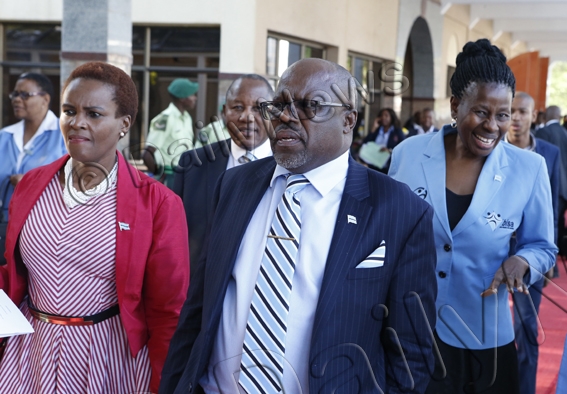
President Lt Gen. Dr Seretse Khama Ian Khama says government has made good progress in the realisation of the Millennium Development Goal of universal access to primary education with 96 per cent of children now entering primary school.
Delivering the State of the Nation Address on November 6, President Khama said there was now the need to focus on quality basic education and lifelong learning.
He added that government in partnership with the private sector had made strides with the introduction of pre-primary education in an effort to ensure learner readiness at Standard One.
He said government’s efforts had seen an increase in the number of public primary schools offering reception classes from 382 in 2016 to 471 in 2017.
He noted that there had also been an increase in enrollments from 16 536 to 20 361.
He also noted that approximately 38 per cent of the Standard One intake in 2018 would have benefited from pre-schooling.
He added that the introduction of pre-primary education was part of a much larger education sector reform, as government was currently implementing the Education Sector Strategic Plan (2015-2020) designed to transform the sector.
“One of the major challenges is the provision of a learning environment that caters to students of varied,” he said.
He said government has embarked on several reforms in the curriculum which include a multiple pathways approach to secondary education and an outcome based approach to assessment.
The resulting expanded curriculum, he said, would allow learners to choose between academic, professional and technical pathways with the first phase of the implementation of the multiple pathways programme scheduled for January 2019.
President Khama added that to better equip children with 21st century skills, government in conjunction with stakeholders, had increased the use of ICT in schools.
He said government 2017/2018, in partnership with Mascom, provided an additional 60 schools with ICT gadgets and also connected them to the Internet.
He said government had also commenced phase II of the project which would see the supply of ICT gadgets to an additional 152 primary schools, 70 junior schools and 10 senior secondary schools by the end of 2018 with electrification support.
He noted that Mascom and BOFINET had also committed to connect an additional 210 schools to the high speed broadband Internet, adding that the joint initiative had so far connected Internet to 140 junior and 25 senior secondary schools.
He said the Universal Access Service Fund has further provided connectivity to 74 schools, and that government would continue to address welfare issues surrounding education such as the provision of housing for staff.
President Khama said 292 teacher’s houses that were started in the 2016/17 financial year would be completed in 2018.
He said for the three year period of ESP, government planned to construct 401 classrooms and 486 teachers’ quarters across 123 primary schools countrywide.
He said the construction of primary school facilities has continued in the current financial with 161 teachers’ quarters and 149 classrooms to be constructed in 55 primary schools at an estimated cost of just over P373 million.
He said the Ministry of Tertiary Education, Research, Science and Technology was established in October 2016 with the responsibility to facilitate human resource development and coordinate research and science.
He said there has been a significant increase in local tertiary education enrollment, which had risen from 31 129 in 2007/08 to 56 447 in 2016/17.
The growth, he said, could be attributed to government’s decision to sponsor students in local private tertiary institutions, thus reducing the high cost associated with external placements.
He said it had also resulted in the rapid expansion of the skills base of the graduates that should not only translate into improved service delivery, but also to a reduction in expenditure on allowances such as overtime and scarce skills.
During the past decade, he said government had also implemented various projects that facilitate improvements in access to tertiary education which include the establishment of the Botswana International University of Science and Technology (BIUST), which produced its first graduates this month.
He highlighted that Botswana College of Open and Distance Learning was established with the mandate of making education accessible to out-of-school youth and adults through the provision of education by open and distance learning mode.
He said in July this year, the college was transformed into Botswana Open University.
President Khama, however, said government was financially constrained to keep up with the exponential growth in demand for tertiary education sponsorship amid competing priorities, saying government had started to explore options for sustainable funding. ENDS
Source : BOPA
Author : BOPA
Location : GABORONE
Event : Parliament
Date : 08 Nov 2017
Related News

25 Aug 2026
Forensic audit generates 90 priority actions
25 Aug 2026