


Makobo women roll up sleeves
15 May 2017
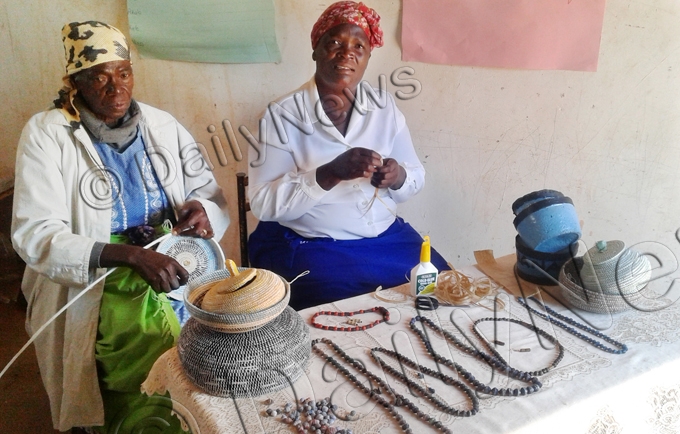
Participants of the Out of School Education Training (OSET) programme at Makobo have been introduced to the art of designing handcraft items, says OSET facilitator, Ms Wisiso Moffat.
In an interview, Ms Moffat said though OSET aimed at closing the illiteracy gap among the elderly, they also felt the need to come up with a practical activity so as to enhance the daily activities of the programme.
She said the designed items included, fashion accessories such as necklaces, bracelets, press studs, baskets and flower pots.
All these items, she said were designed using pieces of cloths, dried kernels of wild fruits and pieces of bones.
Ms Moffat revealed that it had come to their attention that some elderly people enrolled under the programme easily got bored to be engaged in books throughout, a situation which led to some dropping out before they could even grasp the basics of reading and writing.
Ms Moffat said in an effort to address the challenge, they introduced the art of designing.
“We have been experiencing a lot of drop outs with reasons that the elderly cannot be engaged in reading and writing for a longer time.
As such, we introduced them to the art of designing handicraft items with the intention to keep them engaged and allowing them time to interact and share skills,” she said.
Ms Moffat highlighted that the OSET classes lasted for a period of three hours on weekly days, therefore two hours were often spared for reading and writing and the remaining hour was for the practical work.
She said art was introduced in 2015, after she completed a short training course in relation to the design of fashion accessories and ornamental things.
“Upon completion of this course, I felt the need to voluntarily share the skills with OSET participants so as to lure them back to the programme.
This has helped much because the number of participants has increased to 15 from nine that was left,” she said.
Ms Moffat further said since the elderly had been introduced to the design activity, they had rolled up their sleeves with the inten
tion to work an extra mile.
She also said the idea to allow them sell any designed items for personal gain also influenced them to be actively involved.
Meanwhile, one of the participants Ms Mantswaneng Lekani noted that she did not regret her afternoon time that she spent attending OSET classes.
She said through the programme, she had managed to acquire double benefits; she covered her illiteracy gap and gained skills that helped her make ends meet.
Ms Lekani settled for jewellery making, saying with the demands of items such as necklaces and earrings she was well convinced that her products would not go to waste.
“Making these handicrafts is relatively easy. I use papers, glue and dried bones and kernels cut into the desired shape.
I also use a string to hold pieces of necklaces together and a hooky metal for the earrings,” she said.
Ms Lekani also said she covered the dried bones and kernels with pieces of German print pieces of cloths so as to come up with appealing products.
She also said she used glue to roll pieces of paper into tinny balls and also coat them with a vanishing paint so as to create a layer that could stay longer. Her end products range from P10 to P25 depending on the item.
Another beneficiary, Ms Agnes Jase also sang praises about the wonders of the OSET programme.
She narrated that through the programme her weaved crafts made satisfactory profits that helped her provide for her family.
She said though she had not been to any competition, she was satisfied with the exposure she received at OSET.
Ms Jase also said though they halted classes during ploughing season, it gave her time to sell her field produce. ENDS
Source : BOPA
Author : Chendzimu Manyepedza
Location : MAKOBO
Event : interview,
Date : 15 May 2017
Related News

21 Aug 2026

20 Aug 2026
Botswana Donates FMD Vaccines To Lesotho

20 Aug 2026