


Diabetes story From the horses mouth
12 May 2017
I happen to be diabetic and the way I discovered it was sort of a gruesome experience.
It happened when I was attending a wedding on December 10 2016 at Mmankgodi.
The day was bright and hot and I was drinking water; a bottle after the other. Moreover, every time after a meal I was struck by hunger.
On my way back home I realised that my vision was blurry and upon reaching home I surfed the internet to check what might be the problem as I was guided by the signs, such as frequenting the bathroom, too much water intake and eating non-stop.
As I was perusing through the pages I came across a topic titled Diabetes Symptoms and I decided not to read further and waited for the next day.
It was around 745am when I asked my wife to drive me to the clinic.
Upon arrival I asked a nurse for a blood sugar level check, which request she rejected, telling me that patients have a tendency to self-diagnose.
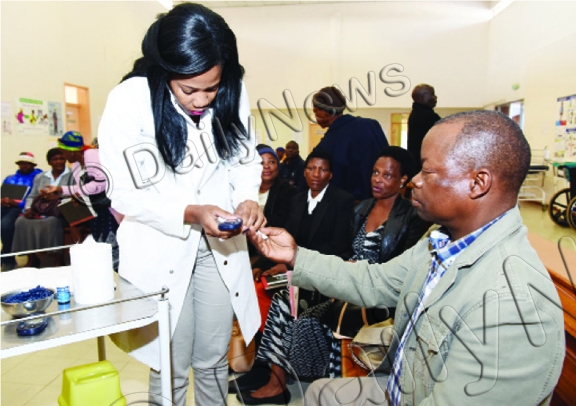
After some further negotiations she agreed to my request and found that my blood sugar level was way high, registering 33mmol/L on the gluco-meter.
From that moment I was left with no option, accept that I am diabetic.
The rest, as they say, is history. I am now leading a happy and wholesome life with proper management of my condition.
Now that I have accepted my condition as a diabetic, I felt the need to research intensively , especially through website engines such as Google, and acquaint myself with issues surrounding the disease.
As such, I found it imperative to share the following information with the readers:
Diabetes, often referred to by doctors as diabetes mellitus, describes a group of metabolic diseases in which the patient has high blood glucose (blood sugar), either because insulin production is inadequate, or because the body cells do not respond properly to insulin, or both.
Symptoms of high blood sugar include frequent urination, increased thirst, and increased hunger.
According to Oxford Advanced Learner’s Dictionary, The term ‘‘mellitus’ as in diabetes mellitus means ‘honey-sweet’.
Diabetes mellitus was first identified as a disease associated with ‘sweet urine’ because when blood glucose is elevated (hyperglycemia), it spills glucose into the urine.
Diabetes can strike anyone, from any walk of life, irrespective of age or gender
To understand what diabetes is, one first needs to understand the role of insulin in the body.
When one eats, their body turns food into sugars, or glucose.
At that point the pancreas is supposed to release insulin, which serves as a ‘key’ to open body cells to allow the glucose to enter and be used for energy.
But with diabetes, this system does not work. Several major things can go wrong - causing the onset of diabetes.
Type 1 and type 2 diabetes are the most common forms of the disease, but there are other kinds such as gestational diabetes, which occurs during pregnancy.
What is type 1 diabetes?
The more severe form of diabetes is type 1, or insulin-dependent diabetes.
It is sometimes called ‘juvenile’ diabetes, because it usually affects children and teenagers, although it can develop at any age.
With type 1 diabetes, the body’s immune system attacks part of the pancreas.
Scientists are not sure why.
But the immune system mistakenly sees the insulin-producing cells in the pancreas as foreign, and destroys them.
This attack is known as ‘autoimmune’ disease.
The islets are the ones that sense glucose in the blood and, in response, produce the necessary amount of insulin to normalise blood sugars.
As insulin serves as a ‘key’ to open body cells, to allow the glucose to enter and be used for energy, without insulin, there is no entry into the cell, as such the sugar stays and builds up in the blood stream.
This results in the body cells starving from lack of glucose.
If left untreated, the high level of ‘blood sugar’ can damage eyes, kidneys, nerves, and the heart, and can also lead to coma and death.
Insulin Therapy
A patient with type 1 diabetes treats the disease by taking insulin injections.
This foreign source of insulin now serves as the ‘key’ to the body’s cells, allowing glucose in.
The challenge with this treatment is that it is often not possible to know precisely how much insulin to take.
The amount is based on many factors, including; Food, Exercise, Stress as well as Emotions and general health
What is Type 2 Diabetes?
This is the commonest form of diabetes, or non-insulin dependent diabetes.
It is also called ‘adult onset’ diabetes since it typically develops after age 35.
However, a growing number of younger people are now developing type 2 diabetes.
Patients with type 2 diabetes are able to produce some of their own insulin, but it is often not enough.
Sometimes the insulin will try to serve as the ‘key’ to the body cells, to allow the glucose to enter, but the cells won’t open.
This is called insulin resistance.
Often type 2 diabetes is associated with overweight people with a sedentary lifestyle.
Treatment focuses on diet and exercise. If blood sugar levels are still high, oral medications are used to help the body use its own insulin more efficiently. In some cases, insulin injections are necessary.
International Diabetes Federation (IDF) which Botswana is a member of, in 2015 estimated the prevalence of diabetes in Botswana to be four per cent of the adult population aged 20 and 79, which translates to 52 000 people with diabetes in Botswana.
Head of Princess Marina Hospital Diabetes Centre of Excellence, Dr Aderonke Oyewo however said in an interview that about half of the people with diabetes in Africa are not even aware that they have the condition and so do not access management or medication. This number is said to be around 32 000 adults in Botswana.
Dr Oyewo said worldwide it afflicts more than 380 million people.
World Health Organisation estimates that by 2030, the number of people living with diabetes will be more than double.
She said today, diabetes takes more lives than AIDS and breast cancer combined, it is a leading cause of blindness, kidney failure, amputations, heart failure and stroke.
Dr Oyewo said living with diabetes places an enormous emotional, physical and financial burden on the entire family. Annually, diabetes costs the American public more than $245 billion.
She said in Botswana, the Ministry of Health and Wellness is at the forefront of the management of diabetes, thus centres of excellence for the management of diabetes have been established in Block 6 and Princess Marina Hospital in Gaborone and Donga and Nyangabgwe in Francistown.
She said there are also five screening sites nationwide for patients with diabetes to have their eyes checked and two treatment sites where patients are referred for treatment of the eyes.
The doctor said the International Diabetes Federation (IDF) stresses the fact that the numbers of people living with diabetes will continue to increase globally if no action is taken.
In 2015, it was estimated that there were 415 million adults with diabetes globally and this is projected to increase to 642 million by 2040.
She said it is importance of eat local produce, which is more available and affordable such as sorghum and spinach, among others.
Patients are discourage from buying products which are labelled ‘diabetic Diets or foods’ found in shops as they are expensive.
Dr Oyewo stressed the need to pay attention to the quality of the food being eaten.
They should be high in fibre, low in fat and low salt, but equally important is the quantity of the food.
She said there is need to control the portion sizes, especially the amount of the carbohydrates or starchy foods being eaten at each meal.
Balancing Act
These factors fluctuate greatly throughout the day. So, deciding on what dose of insulin to take is a complicated balancing act.
If you take too much, then your body burns too much glucose and your blood sugar can drop to a dangerously low level.
This is a condition called hypoglycemia, which, if untreated, can be life-threatening.
If you take too little insulin, your body can again be starved of the energy it needs, and your blood sugar can rise to a dangerously high level, a condition called hyperglycemia.
This also increases the chance of long-term complications. ENDS
Source : BOPA
Author : Aubrey Maswabi
Location : GABORONE
Event : Interview
Date : 12 May 2017
Related News

21 Aug 2026

20 Aug 2026
Botswana Donates FMD Vaccines To Lesotho

20 Aug 2026