Residents finally appreciate coffin business
21 May 2014
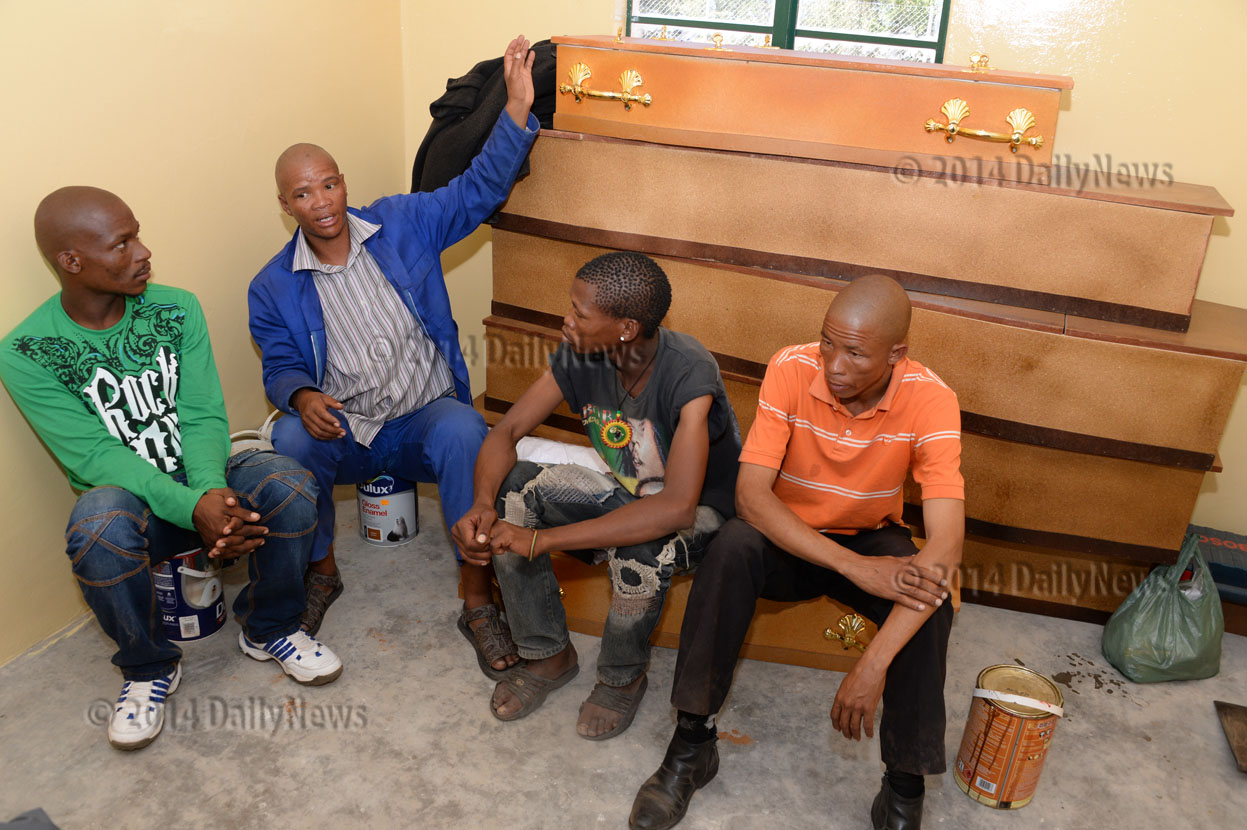
Two years ago, Mr Xukuri Kerayahela would have to strengthen his soul and gather maximum courage every time he wanted to wander into the small village of Qabo in the Ghanzi District.
And, with a population of just over 700 people, everybody in Qabo surely knows each other so much that everything that unfolds cannot escape the ears and eyes of the small village.
At the time, and at just 33 years of age, Mr Kerayahela, together with his five business partners, were considered a curse in the village. Fellow residents avoided them like they would someone plagued with leprosy; they presented them to the community, especially children with negative comments.
In fact, the majority of the populace even wanted them banished to faraway places such as Ghanzi township. Every time there was a report of a death in the village, hush tones and accusing fingers pointed their way, and the community only came short of calling them criminals.
All this was however, not because Mr Kerayahela and group were actually criminals, but all because of the nature of business they had chosen to venture into.
In a small village the size of Qabo, where obviously superstition still rules some people’s lives, nobody had ever thought that a mentally fit person could ever run a coffin manufacturing business.
“That was two years back, and down the line the residents have now warmed up to the idea that business is business. Time and again they drop by to admire our work. You see, everything can be accepted in society once people get used to it,” Kerayahela shyly reminisces the days gone.
He says the residents, simple as they are, thought coffins were manufactured by white people somewhere in faraway places. However, they have now accepted the products so much that some even want to join the company.
However, because their business is still at an infancy stage, they cannot afford to employ anyone.
With most poverty eradication beneficiaries preferring ordinary projects like bakery, dressmaking and backyard gardening, Kerayahela says they had to think outside the box to harness a virgin market that was not yet saturated, and will not be in a long time to come; that was how Ke botshelo Carpentry was born.
“We knew that coffin manufacturing was not yet tapped into, and with our village mostly populated by the non-working class, we decided to focus on cheap types to make a good business kill,” he points out.
The coffin maker says in 2012, the Department of Social and Community Development (S&CD) sponsored them to the tune of P20 000 to start their business.
The following year the department injected a further P33 000 into the business, which he said does not require any complicated material as they only need sheets of chipboard and black board for lining.
Kerayahela says even though they had targeted the low class in their village, they later realised that people still preferred to buy coffins in Ghanzi because that is where there is a mortuary.
“People use the mortuary in Ghanzi and prefer buying coffins there rather than buying them here and transporting them to Ghanzi where the corpse will be, and now our main customer is the S&CD,” he says.
The problem is that the council can take up to a month without the payment of the previous month’s supply, says Kerayahela, adding that such practice hinders their progress because sometimes they fail to fulfill orders because of no money to buy materials for new orders.
His concerns are shared by one of his partners, Moretlwa Qaraga, who says they have long made their concerns known to the council as it might make them lose people’s trust.
However, the Community Development Officer for Qabo, Ms Neo Kebonye refutes the allegations saying: “The issue of late payment occurred only once because the prices in the Local Purchase Order (LPO) did not match those in the invoice.
It was actually an error by the manufacturers themselves because when we ordered the coffins the price was P1 100, but then they got wind of news that the council was planning to increase the price to P1 500,” she says.
“That was the only delay ever since we worked with them. In fact, the council is their sole client and there is no truth in the statement that clients are losing interest in them because of the delay,” she says.
It actually turns out that the manufacturers cannot actually satisfy the council demand as they always produce fewer coffins than the council needs. The council sources coffins from them for destitute persons in places like Ghanzi and Charleshill.
On why they only focus on the “S&CD” types of coffins, Kerayahela says they have not yet done much design patterns, which makes it difficult to diversify the types of coffins they manufacture.
Despite their skills at designing and crafting the coffins, Kerayahela says they never went to school, but learnt the skills from their chairman, Charles Camm, who was trained in carpentry at the Rural Industries Innovation Centre (RIIC) in Kanye.
He says they are still in negotiations with the S&CD to take them for carpentry training at a brigade college.
“Personally I have been in love with carpentry from my youth and I even did Design and Technology at junior school.
Actually before we were funded as a group I was planning to approach the S&CD and seek for funds to start a carpentry project with focus on small items like tables,” he says.
He says they can produce about four coffins a day, and on the future of the project, Ms Kebonye says since its market is unlikely to be saturated in the near future, it has the potential to grow into a large scale production.
“We still have to work hard in instilling the culture of independence and commitment in them. They have to know that just like the white collar jobs, they too have to wake up every morning and follow operational hours, not just abscond from work whenever they wish,” she says.
She however, says that she has trust in the Ke botshelo Carpentry to weather the storm.
And now that they are no more looked at with a skeptical eye, the now six member group can walk with heads up across the village, visit entertainment spots and hope that one day parents will point them out to their kids not with negative comments, but with pride as an example of successful business men rather than something close to a criminal. Ends
Source : BOPA
Author : Olekantse Sennamose
Location : QABO
Event : Interview
Date : 21 May 2014
Related News

04 Aug 2026



03 Aug 2026
De Beers output surges in 2026 first-half

03 Aug 2026