No more broadcasting
02 Mar 2014
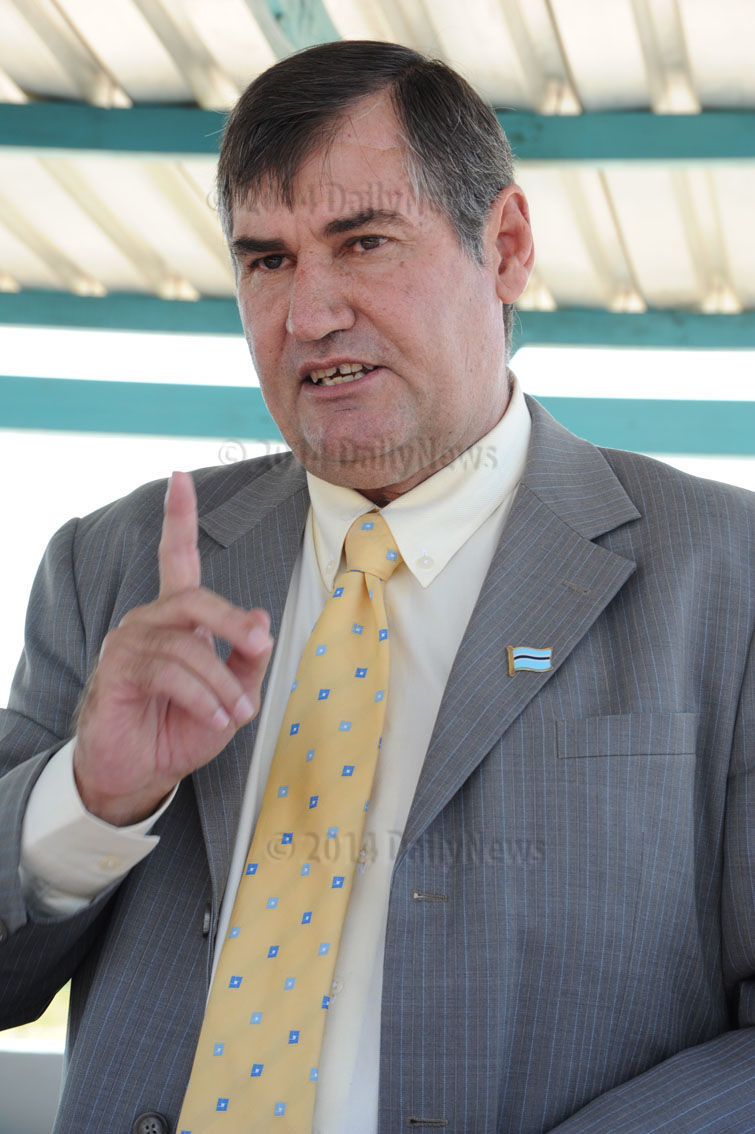
Minister of Agriculture, Mr Christiaan De Graaff, has urged farmers to do row planting in order to manage their fields and produce better yields.
Addressing farmers in a kgotla meeting at Kopong in Kweneng District on February 27, Mr De Graaff explained that his ministry would not allow broadcasting next ploughing season.
He explained that it was only allowed this year because of the late rains. He said weeding was important hence farmers needed to do row planting because weeds competed with crops for nutrients and water. Furthermore, the minister explained that broadcasting did not allow farmers to apply fertilisers while walking in between crops for inspection was also difficult.
He added that the method did not produce better yield. Minister De Graaff also explained that agriculture was the backbone of the country, thus must be improved and taken up as a business and not as a hobby to improve livelihoods of Batswana.
He further told farmers that government had introduced good schemes and support programmes to address challenges in the agricultural sector.
Last year, he said, drought was declared in the country which prompted the ministry to come up with various support schemes, including the improved Integrated Support Programme for Arable Agricultural Development (ISPAAD).
In future, he also said the country must be self-sufficient and stop imports from neighbouring countries. As a result, he said, the ministry had categorised farmers in three groups of commercial, emerging and subsistence.
The minister also highlighted that small scale farmers were playing a significant role in agriculture to help the country become self-sufficient, adding “I always say it is not how big you are, but how serious you are.”
Botswana Meat Commission (BMC), for instance relied on subsistence farmers for continuous supply of cattle. On the other hand, farmers complained that tractors were insufficient in their area.
They argued that those that were available did not have equipment. Again, farmers indicated that though the fencing component proposed by government was a good initiative, the 50 per cent contribution they were supposed to pay was too expensive for them.
Furthermore, they told the minister that they did not have a veterinary assistant in their village hence being forced to travel to seek help from Lentsweletau.
In response to a concern by farmers on the issue of shortage of tractors, Mr De Graaff explained that his ministry came up with a package for tractor owners because in the past, fields were only ploughed and not put into full production which resulted in the Arable Land Development Programme (ALDEP) failing.
He said there was business opportunity for tractor owners in the newly improved ISPAAD programme which has been running for three years. “By now we expect tractor owners to put their profit aside to buy implements,” he added.
Minister De Graaff further said even when ploughing using donkeys, one could turn the soil around, and raw plant by using a rope to make a straight line with small holes dug along the rope and then drop seeds into the small holes together with the fertiliser.
The minister also explained that prices of ploughing using animal draught power were the same as using a tractor provided everything was done properly.
He also acknowledged that the fencing component was expensive. He said under the ALDEP programme, government was paying 85 per cent of the total fencing costs while farmers only paid 15 per cent.
As a result, Mr De Graaff said there were many fields fenced but not under production. “That is why a 50/50 contribution in the individual fencing package where by government and the farmer share costs was introduced. That way, only serious farmers will uptake the programme,” he added.
In high production areas, he said revised cluster fencing has been introduced and government pays 100 per cent subsidy.
However, Mr De Graaff said it was worrying that government fenced fields but there was still no production in some of them.
Minister De Graaff also promised farmers that they will get a veterinary assistant but he urged them to continue getting services from Lentsweletau because their officer was still involved with the Livestock Identification and Trace Back System campaign.
On other issues, he said government was embarking on phase one of the Livestock Identification and Trace Back system.
On exportation of beef, he said everyone must ask what Botswana had done right to still export beef to the European market and what have other countries done wrong.
He said Botswana was one of only three countries including Namibia and Swaziland that can still export their beef to the European market.
Namibia has about 80 per cent to 90 per cent of their livestock farms fenced and that is not the case with Botswana.
In Botswana, he said 90 per cent was open communal area while only 10 per cent of farms were fenced but because the livestock identification trace back system was in place, the country was able to sell its beef to EU.
“With that in mind, the government is doing away with the bolus system and replacing it with the manual and electronic ear tags. Phase one is expected to be complete by the end of April,” he said.
He however said those who wanted to sell their livestock to BMC will have both the bolus and the electronic ear tag inserted while government will bear all costs of phase one. “Phase two will then commence thereafter and farmers will bear the costs.
The manual ear tag will roughly cost around P15.00 and there will be available in livestock advisory centres country wide,” he said. ENDS
Source : BOPA
Author : Lindi Morwaeng
Location : MOLEPOLOLE
Event : Kgotla meeting
Date : 02 Mar 2014
Related News
04 Aug 2026


03 Aug 2026
De Beers output surges in 2026 first-half
03 Aug 2026