President acknowledges emotional toll of policing
19 Feb 2026
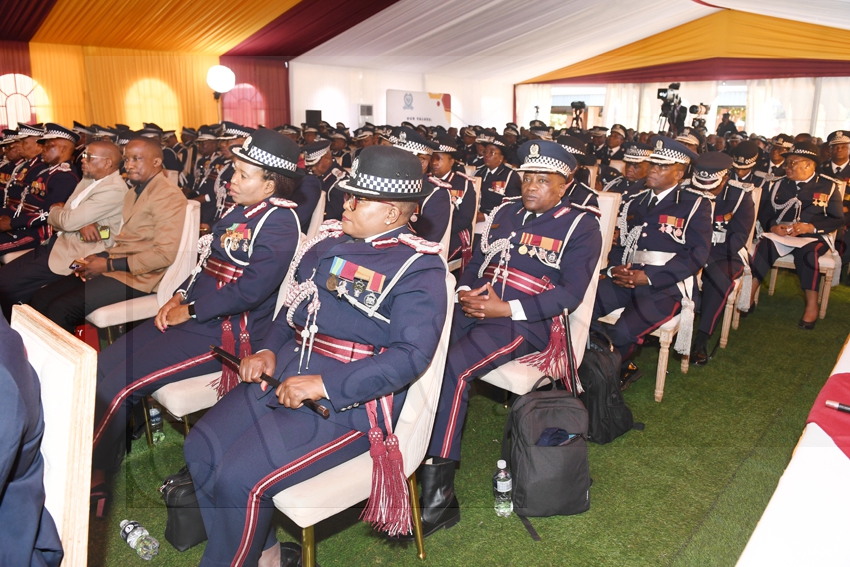
Nestled at the foothills of the iconic Lentswe La Baratani hill, men and women in uniform gathered at the Botswana Police College as President Advocate Duma Boko steered their spirit, strengthened their trust and emphasised the importance of integrity in daily policing.
President Boko spoke with a heavy heart, expressing a sombre mood in his opening address about the death saturated environment police face, subjected to distressing situations including among others suicide-murder incidents, fatal car accidents and violent crimes which took a heavy toll on their mental wellbeing.
He acknowledged that the work environment was filled with upsetting situations but took a bow to the immense resilience shown by the men and women in uniform to navigate their responsibility effectively.
Despite these harsh realities, the President praised officers for resilience, discipline and continued commitment to protecting the nation.
“We know and acknowledge all these calamities, I assure you that we shall prevail against all odds. Let us seek new and innovative interventions of addressing these persistent problems in your line of duty. We applaud your strengthened resolve to discharge your duties diligently in the midst of all these,” added President Boko.
Speaking during the 52nd Botswana Police Service (BPS) senior officers annual conference President Boko told the officers that they should be motivated by the positive milestones achieved throughout the years despite the challenging setbacks.
The conference, held under the theme: Policing with purpose, inspiring confidence through resilience and innovation, repeatedly erupted into applause as the President recognised the sacrifices officers make in difficult and often dangerous circumstances.
Turning to the future of law enforcement, President Boko urged the service to modernise rapidly in order to confront organised and technologically sophisticated criminal networks. He emphasised that the success of both Botswana and its police service depended heavily on the speed and depth with which institutions embrace innovation.
“Our success as the Republic of Botswana and as BPS is dependent on the level, scope and pace of innovation. We must review, revise and reform all procedures, processes and techniques we deploy to make our job easy,” he said.
President Boko said the police must embrace technological responsiveness to augment human capability and extend the desired reach. He added that they must be digitally advanced to curb emerging crime trends which were a threat to public safety and investor confidence.
He warned that failure to adapt could allow emerging crime trends to threaten public safety while simultaneously weakening investor confidence.
“We are now forced to diversify the economy under pressure of calamity. The global economy now turns out to be the most unequal in history. The difference between the haves and have nots is enormous,” he said. The BPS of today has evolved from three forces namely the Bechuanaland Mounted Police of 1884, the 1885 Bechuanaland Border Police and Bechuanaland Protectorate Force of 1902.
President Boko further linked policing challenges to broader national development concerns, noting that crime, drug and alcohol abuse and persistent road fatalities were imposing a heavy economic burden.
He said these social problems were undermining efforts to revive the economy at a time when Botswana was already navigating global inequality and structural economic pressures.
“All these have an alarming cost to the economy. The costs run into millions of pula. We are now forced to diversify the economy under pressure of calamity. The global economy has turned out to be the most unequal in history, with an enormous gap between the haves and the have-nots,” he said. The modern Botswana Police Service traces its origins to three early colonial formations: the Bechuanaland Mounted
Police (1884), the Bechuanaland Border Police (1885) and the Bechuanaland Protectorate Force (1902).
Following independence in 1966, the institution became the Botswana Police Force before undergoing a major organisational transformation and rebranding in 1997 to become the Botswana Police Service.
From its early structure of just two divisions , North and South the service has expanded to five divisions and developed specialised operational branches including forensic science, cybercrime investigation and aviation support. The Air Support Branch, introduced in 2009, significantly strengthened aerial patrol capacity, particularly in remote and difficult terrain.
Operational campaigns have also played a central role in policing strategy. The long-running festive-season 60 Days of Action on Crime and Road Safety initiative was rebranded Operation Pabalesego in 2024 and launched by President Boko in Mogoditshane.
Similarly, the anti-livestock theft KgomoKhumo operation introduced in 2018 has delivered sustained enforcement success, resulting in numerous arrests and prosecutions nationwide.
Specialised policing capabilities include the well-known K9 section a fully-fledged dog unit operating under the Special Support Group, the service’s paramilitary wing responsible for high-risk support operations and anti-poaching duties.
The service also marked a gender milestone in 1971 with the recruitment of its first eight female officers.
A further structural transformation came in 2009 when the Botswana Police Service merged with Botswana Local Police, creating an integrated national policing system. ENDS
Source : BOPA
Author : Baleseng Batlotleng
Location : OTSE
Event : 52nd BPS senior officers annual conference
Date : 19 Feb 2026
Related News

05 Oct 2026

05 Oct 2026
Balance tourism growthwith ecological protection

05 Oct 2026