

The Lokgwabe community launches Nama Online Radio
19 Feb 2026
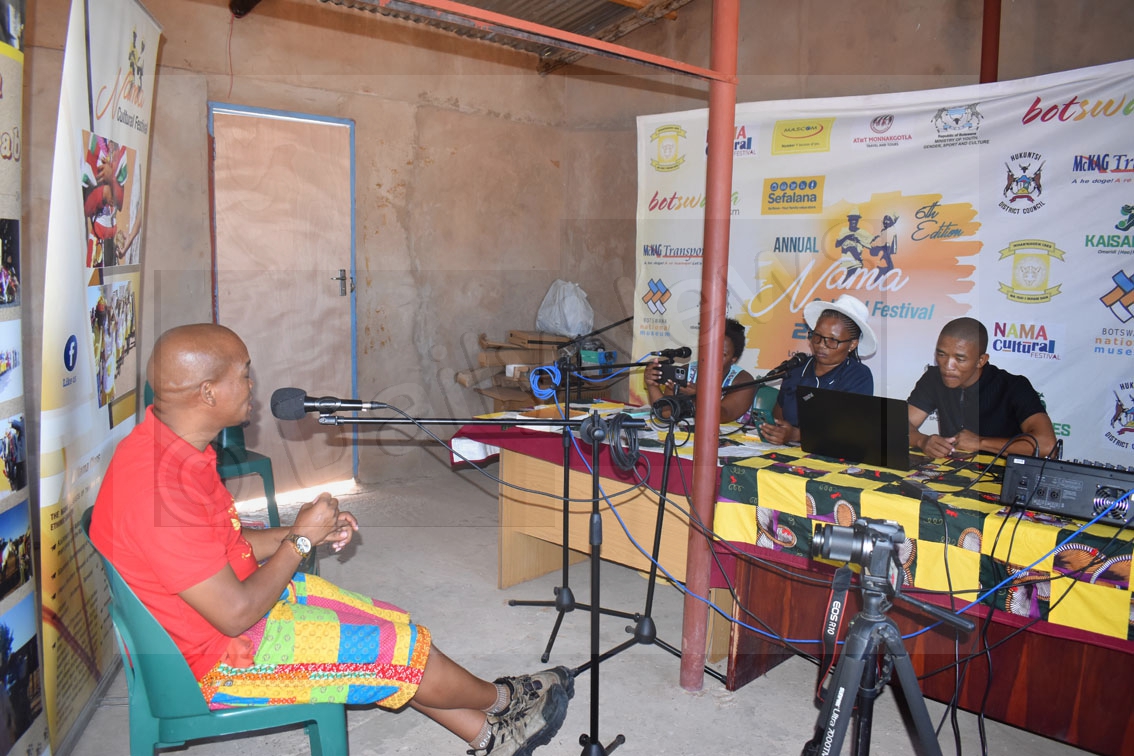
The Lokgwabe community has taken a decisive step towards safeguarding its cultural heritage with the launch of Nama Online Radio, an initiative aimed at promoting and revitalising the Nama language.
There is a general fear among residents that the language is steadily losing ground to dominant languages.
The project answers government’s call to preservation and broadcasting of indigenous languages through the establishment of community radio stations across the country.
For the people of Lokgwabe, the station is more than a communication platform, it is a cultural lifeline intended to restore pride in their identity and provide a voice for a community that has long felt marginalised in mainstream discourse.
Nama Development Trust chairperson, Nicholas Cooper, told BOPA that the online station was funded through the Cultural Survival Fund, an international non-governmental organisation based in the United States with a regional office in Cape Town, South Africa.
The fund had invited proposals for a 10-month indigenous radio establishment programme, for which the trust successfully applied.
Now in its second month of operation, the station has already hosted a three-day intensive training workshop, facilitated by Kaisames Radio Station of Namibia.
The indigenous broadcaster was engaged to equip the project team with essential skills in broadcasting, ethical journalism and content production.
“The initial plan was to train 10 presenters, but the project scope provided for four presenters, a coordinator and a project officer who are responsible for the day-to-day running of the station,” said Cooper.
He noted that the primary objective of the radio station was to create a platform through which the Nama people could discuss issues affecting them in their own language and from their own perspective.
“Indigenous communities across the world often remain unheard because they are minorities and most public discourse is dominated by majority groups. This radio station is meant to give us a voice and ensure that our concerns reach both our people and policy makers,” he said.
Although the station prioritises Nama, about 30 per cent of its programming is broadcast in Shekgalagari, Setswana and English, to accommodate the broader community and encourage inclusivity.
Cooper said years of cultural assimilation had resulted in many Nama people, particularly the younger generation, speaking less of their mother tongue in favour of more dominant local languages.
“Through the radio, we want to encourage our people to speak Nama again. Language carries identity, history and pride. When people begin to speak it more frequently, they revive the spirit of the community,” he said.
The station’s programming also addresses youth development, human rights, climate change, gender issues and the preservation of cultural heritage. Content is carefully prepared to meet ethical journalism standards, a principle Cooper said was emphasised during training.
Nama Online Radio currently broadcasts live from 9am to noon on Mondays, Wednesdays and Fridays, with a second live session from 6pm to 9pm. A dedicated one-hour children’s programme airs on Sundays and focuses on teaching the Nama language through educational content.
“So many children cannot speak Nama, so we are deliberately using radio as a learning platform to reach them at an early age,” he said.
Evening programmes feature live interviews with relevant stakeholders on topical issues. Traditional leaders have already been engaged to discuss challenges such as stock theft and possible solutions for the district.
Cooper said listener feedback had been encouraging, noting that the project was still in its formative stages and that presenters would continue to receive training to enhance their professionalism and improve content quality.
Looking ahead, the trust plans to engage the Botswana Communications Regulatory Authority with the aim of transitioning from an online platform to a fully-fledged frequency-based community radio station once the 10-month project period ends.
“Online radio limits listenership because it requires smartphones and reliable internet access. Our long-term goal is to operate a community radio station that can be accessed by everyone while still maintaining our online presence,” he said.
He welcomed government’s commitment to community broadcasting and the dissemination of news in indigenous languages, describing the project as timely and aligned with national development priorities.
Beyond language preservation, the initiative is expected to create employment opportunities and open up a value chain that includes presenters, technicians, producers and administrative staff. It is also seen as a platform for nurturing local talent in music, poetry and storytelling, which Cooper said remained largely untapped.
“We want this station to inspire our people, uncover hidden talent and attract qualified journalists from within the community so that it becomes a permanent institution that promotes our language and culture,” said Cooper.
He said Nama Online Radio represented a technological milestone and was a symbol of cultural resilience.
Its coming into being means that the Nama language would be heard, celebrated and passed on to future generations. ENDS
Source : BOPA
Author : Thuso Kgakatsi
Location : Gaborone
Event : Interview
Date : 19 Feb 2026
Related News
21 Aug 2026
21 Aug 2026
Contestants reconnect with culture at bootcamp

19 Aug 2026
Thomas Makes Winning Team

19 Aug 2026
Maake kaNcube Headlines Inaugural Creators

19 Aug 2026