


Private sector to be at the centre of economic transformation
10 Feb 2026
Government has placed the private sector at the centre of Botswana’s economic transformation.
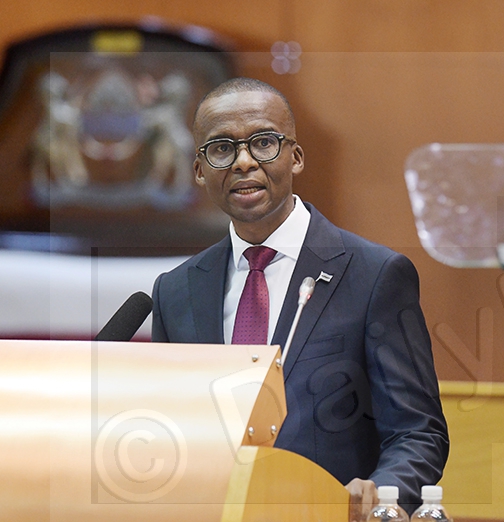
This was said by Vice President and Minister of Finance, Mr Ndaba Gaolathe, delivering the 2026 Budget Speech before Parliament yesterday.
Outlining a reform and investment programme aimed at diversification, export growth and long-term economic resilience, he said government remained steadfast in its resolve to deepen private sector participation as the primary driver of a diversified and export-oriented economy.
He said the strategy focused on improving enterprise competitiveness, accelerating the growth of scalable firms and expanding Botswana’s footprint in regional and global markets.
Also, he said a key pillar of the budget was repositioning of agriculture from subsistence production and import dependence to a modern, agro-industrial and export-focused sector.
He said under the Botswana Economic Transformation Programme (BETP), government was implementing 26 transformative agriculture projects spanning crop and livestock production, agro-processing, cold-chain logistics and market access.
Mr Gaolather also indicated that through clustering models, processing hubs and integrated logistics systems, Botswana aimed to convert its land, water resources and farmer base into competitive exports in meat, horticulture, nutraceuticals and other high-value crops.
He cited a BETP agriculture-based cluster project set to make its first confirmed export of Moringa to Germany in February 2026, describing it as a tangible validation of the cluster-based approach and Botswana’s ability to meet stringent international standards.
Manufacturing, he said was also being strengthened as the bridge between primary production and exports. He further said under BETP, government prioritised 22 manufacturing projects focused on assembly-based manufacturing, resource-based heavy industry, clean technologies and precision manufacturing.
“These projects are designed to link agriculture, mining and energy into higher-value goods, retain value domestically, deepen supply chains and create skilled employment. This shift moves our economy decisively up the value chain and reduces vulnerability to external shocks,” he said.
He said significant progress had also been recorded in Special Economic Zones (SEZs ) and that government had invested P714 million in land servicing and the construction of four advanced factory units at the Sir Seretse Khama International Airport SEZ.
Additionally, he said a P63 million grain dryer and related facilities were under development at the Pandamatenga SEZ to support agro-industrial value chains.
To support geographically balanced growth, he said the Revised National Investment Strategy (2025-2030) was expected to be completed by March 2026.
He indicated that it would decentralise investment by embedding local economic development approaches, developing district-specific investment profiles and strengthening competitive value chains, with implementation led by the Botswana Investment and Trade Centre (BITC) in partnership with local authorities.
“Investor facilitation reforms will continue through BITC and the Botswana One Stop Service Centre, with measures to simplify permits, licenses, and approvals, and introduce direct issuance of investor visas,” he added.
On regional trade, he announced that Botswana completed its National AfCFTA Implementation Strategy in July 2025.
“The strategy positions Botswana to tap into the African market of 1.3 billion people, expanding export opportunities and value-chain integration,” he said.
On human capital development, he said Botswana currently spent an average of 7.1 per cent of Gross Domestic Product on education, among the highest levels for upper-middle-income countries in the region.
However, he acknowledged that outcomes had lagged behind spending, creating an efficiency gap that constrained growth.
“To address this, government has introduced a new Tertiary Education Financing Policy, a Higher Education Act and a dedicated TVET Act. These reforms aim to align skills development with labour-market demand, embed digital and green skills and reposition technical and vocational education as a first-choice pathway into employment,” he said.
Under healthcare, he said government was shifting toward a stronger primary healthcare model, adding that a major reform program would transform the Central Medical Stores (CMS), with expected savings of 30 to 40 per cent in medical supply expenditure within five years.
Furthermore, he said work was underway on National Health Insurance, with the enabling Bill scheduled to be tabled during the current parliamentary sitting.
Meanwhile, Mr Gaolathe highlighted that infrastructure remained a central enabler. Under BETP, he said government had prioritised 26 projects across energy, water and transport.
“Currently, domestic electricity generation meets only 63 to 70 per cent of demand, with imports costing approximately P3.4 billion annually. This has prompted the accelerated implementation of the revised Integrated Resource Plan and increased private sector participation in power generation,” he said.
Such reforms, he said, represented a decisive shift toward a more productive, inclusive and resilient economy anchored by private investment and modern infrastructure. BOPA
Source : BOPA
Author : BOPA
Location : Gaborone
Event : Parliament
Date : 10 Feb 2026
Related News


13 Oct 2026
Expo sparks regional leather expansion
12 Oct 2026
Partnership to boost vehicles maintenance
12 Oct 2026
Farmers urged to treat agriculture as a business
12 Oct 2026