


Southern Africa looks to change mining trajectory
12 May 2022
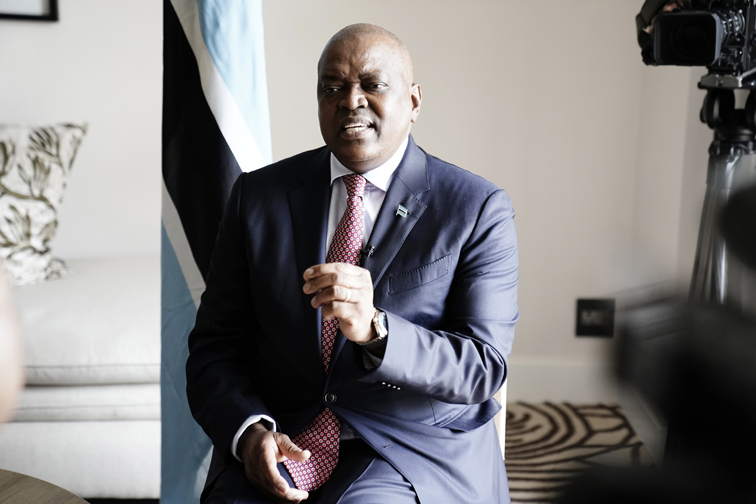
As President Dr Mokgweetsi Masisi reclines on his sofa for an interview with BOPA, Botswana Television and Radio Botswana, the title of the 1980 Star Wars movie, The Empire Strikes Back, comes to mind.
The serene backdrop of the nearby Atlantic Ocean and Table Mountain, peeping slightly through the window, expresses the beauty of the Cape of Good Hope, that probably enticed Jan van Riebeck and the Dutch East Africa Company to establish a “refreshment station” in 1652, and later, former Prime Minister of the Cape Colony, Cecil John Rhodes to envision a “Cape to Cairo” colonial conquest.
Now, as President Masisi and his counterparts from South Africa and Zambia, Presidents Cyril Ramaphosa and Hakainde Hichilema, as well as Democratic Republic of Congo (DRC) Prime Minister, Jean-Michel Sama Lukonde, emerge from a Mining Indaba summit in the very Cape that ignited imperial ambitions, talk is of Africans taking control of their resources, for their benefit.
President Masisi says they have put forth the idea that, “since we are a hotbed of mining globally, we should collaborate in order to benefit more”.
He says for Botswana, modern mining started with the Tati Goldfields in present day Francistown in 1865, with people of European descent exploiting the resource they found, for their benefit.
He says it was only with the discovery of mineral deposits after independence that Batswana got to be in control of ensuring mining benefited them for development.
The President further notes that the Witwatersrand Gold Rush of 1886, which led to the establishment of Johannesburg and South Africa’s industrial hub Gauteng, was also led by settlers of European descent, with Africans providing manual labour.
“Mining in Southern Africa evolved out of conditions of segregation and oppression of the native Africans. Now that we are independent, liberated states, it is incumbent upon us to change this historical trajectory of mining,” Dr Masisi says.
He says it is important that Africans ensure that mining and value chain development benefit their countries and ordinary people.
For this to be brought to fruition, President Masisi feels that Southern African states need to pool their resources and expertise to boost downstream activities to beneficiate and build industries that could garner greater value, in terms of wealth generation and job creation.
Another issue is that Botswana, sitting on over 100 million tonnes reserves of coal, far more than is utilised, now faces a situation where the industrial world is urging developing states to lessen the use of coal in favour of green technology.
Acknowledging that the concern over how resources such as coal affects the environment was a fair one that we share, the President however, says it should also be fair, adding “we need a just transition”.
He says in terms of carbon emissions; Botswana was not a major polluter compared to the industrialised states.
“While we are committed to the use of green technology, we believe we should still benefit from our coal reserves, using clean coal technology, in a fair transition as we have agreed to during the Paris Agreement,” he stresses.
Should Southern African leaders succeed in ensuring the region indeed becomes a global hub, not just for mineral extraction, but the development of strong manufacturing from the beneficiation of minerals, it would be poignant that such a discussion would have been ignited from the Cape of Good Hope, where the conquest of the region started nigh four centuries back. ENDS
Source : BOPA
Author : Pako Lebanna
Location : CAPE TOWN
Event : Interview
Date : 12 May 2022
Related News

07 Aug 2026
Xiplomacy Hosting the world building the future
07 Aug 2026
Xiplomacy Pursuing the greater good for all
06 Aug 2026
Gaolathe inspires learners to aim high
06 Aug 2026