

Farmers to enjoy lucrative market
10 Jul 2013
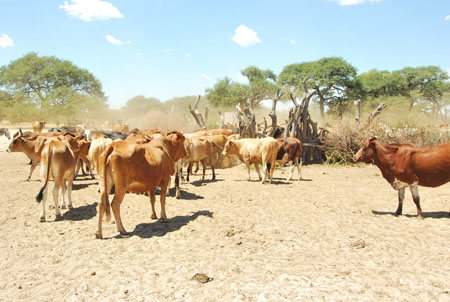
Farmers in the Ngamiland protection zone will soon sell their livestock to lucrative markets when disease control fence currently under construction has been completed.
Responding to BOPA questionnaire, the deputy director of Veterinary Services, Dr Kobedi Segale said the decision to construct the disease control fence was taken to further subdivide the subzone two D into two parts, running on the northern side of the Ngamiland farms from east to west.
He said the idea is part of a long term Foot and Mouth Disease (FMD) control strategy for parts of Ngamiland to ultimately be freed from FMD.
The fenced off area to the south of the fence is bordering with zone 12 (Ghanzi) to the south, zone 4a (Boteti) to the east and Namibia to the west and it will be called the Ngamiland protection zone which is resident to approximately 120 000 cattle, he added.
Dr Segale said the project, initially estimated to cost P38 million and commenced in 2012, was taking long to complete due to financial constraints. It was financed from annual budget savings, he added.
On how the fence will benefit the farmers, Dr Segale said once the area has been freed from FMD the animal and its products originating from this zone would have access to lucrative markets, and ultimately reduce grazing pressure on the range resources.
Dr Segale said the departmental resources that are currently used to control FMD in this area would be freed once the zone is freed of FMD such as vaccination/surveillance teams, vehicles and funds.
Regarding the FMD in the Ngamiland area, Dr Segale said the situation has significantly improved. However, he said, they still record odd sporadic cases and that the threat still remains high due to the heavy elephant challenge on the buffalo fence, which separates buffaloes from livestock.
He cited the flooding of sections of the fence, illegal movement of livestock into zone 16 (buffalo area), uncontrolled livestock movement, the persisting drought situation, buffalo incursions in the livestock area and flooding of the fence patrol access routes as causative factors.
Responding to the question of how the fence would help the situation of the Maun Botswana Meat Commission (BMC) abattoir, Dr Segale said there would be a regular flow of cattle for slaughter, which would meet the daily slaughter capacity of the abattoir. ENDS
Source : BOPA
Author : Aubrey Maswabi
Location : GABORONE
Event : Questionaire
Date : 10 Jul 2013
Related News

09 Jun 2026
09 Jun 2026
Government to review civil litigation practices

09 Jun 2026
Hirschfeld laid to rest
09 Jun 2026
Harvard Health Partnership role significant

09 Jun 2026
SARS cautions foreign motorists against scammers
09 Jun 2026