

Intensify journalists' training
06 May 2013
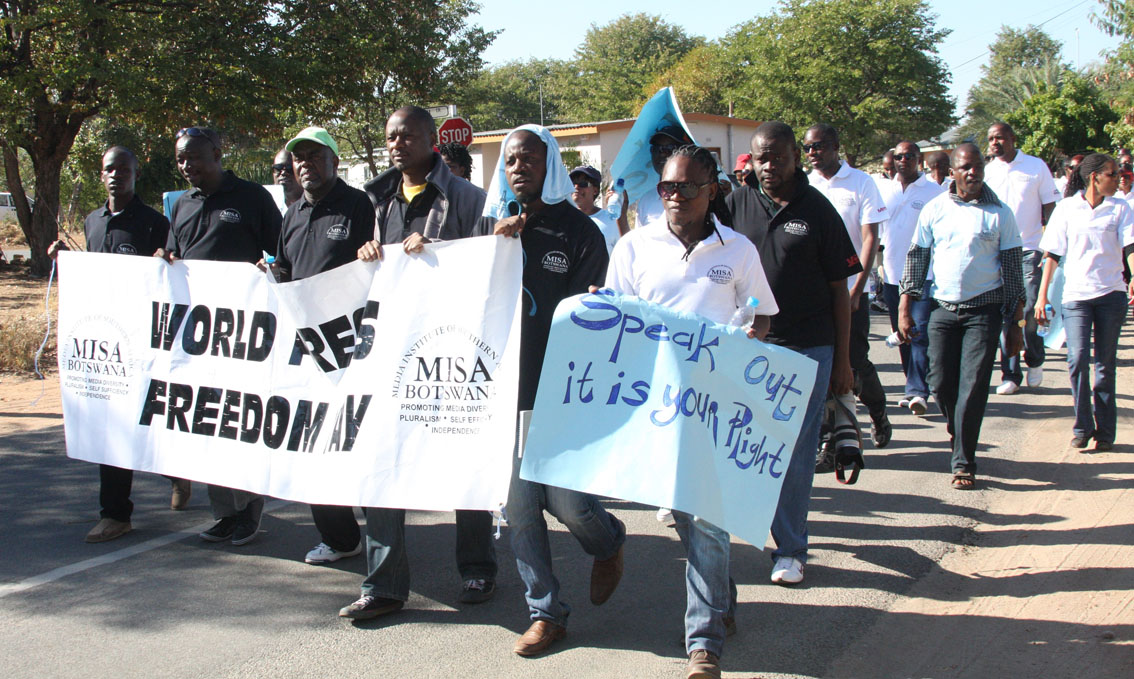
As the world celebrated World Press Freedom Day on May 3, there has been a renewed call to intensify training to continuously capacitate local journalists in their work.
last Friday.The call was made by various speakers during the commemoration.
It was observed that some of the stories that journalists reported locally demonstrated lack of training or complete disregard for journalism ethics because they were not factual.
In an interview on the side-lines of the event, University of Botswana Department of Media Studies lecturer, Ms Nonofo Mankhi emphasised that media practice needed professionals who are able to adapt and change continuously.
She stressed that this called for heavy investment in in-service training for journalists to keep pace with changes that were happening in society as it evolved.
“There is need for the media in Botswana to change their methods of training and communicating with their consumers. The media should also understand the needs of consumers,” she said.
She also observed that there was disconnection between news producers and consumers as the media houses continued churning out news that did not add value to consumers.
Again, she indicated that almost every media house had a slogan, but rarely checked if they met their consumers’ demands.
On other issues, she expressed concern about the level of media training in Botswana and highlighted that journalism schools were following different paths.
Consequently, she added that there was lack of communication between media training institutions on what they were teaching aspiring journalists.
In some instances, she said some of the people who teach media in the tertiary education sector knew very little about the profession.
“This lack of convergence on media training leads to lower standards and poorly trained journalism graduates,” she added.
She gave the example of the University of Botswana where she said some journalism graduates from the media department were already teaching journalism in other institutions before practising the craft or undergoing training to be media mentors.
Currently, she explained that UB produced students to be practising journalists thus they were not yet ready to train other journalists.
She also decried the fact that it seemed as if noone was doing the checks to ensure that relevant media trainers were employed to teach journalism students in some tertiary institutions.
Ms Mankhi also challenged media houses to give honest feedback to media training institutions on the quality of their students.
In addition, she stressed that an English language pass should be a pre-requisite for any student who wanted to study journalism as was currently the case at the University of Botswana.
On the issue of editors, she noted that an editor was like a school principal who knew the workings of the education system and had taught before.
An editor, she highlighted, should be someone who had practised journalism and was good at their craft.
She expressed concern that the advent of inexperienced editors was a contributing factor to poor journalism standards in the country.
Furthermore, she noted that being a long serving employee did not qualify one to be appointed an editor if they were never good reporters.
“Tertiary institutions which offer media studies should set standards for students, while newsrooms should be engaged in continuous in-house training to improve the quality of stories published,” she added.
Francistown High Court Judge, Gaolapelwe Ketlogetswe who was the keynote speaker at the commemoration also emphasised the need for training in the media houses.
“The media in Botswana has had, in a few instances, challenges related to law suits arising out of print material regarded as defamatory of other people,” he said.
The situation, Justice Ketlogetswe observed, was avoidable, if, resources permitting, in-house training and continuous journalistic training could be undertaken.
“I think there are people out there who can help empower newspaper reporters on how to separate facts from comments on those facts, in the same newspaper article,” he said.
MISA Botswana national director, Mr Buyani Zongwani said that they were working on intensifying training for local journalists.
He highlighted that they would be asking media houses to conduct a needs analysis on areas where journalists needed to be capacitated and submit them to MISA, after which they will approach those who could assist them because already some were willing to help in the area of court reporting.
In-service training, he concurred, was of fundamental importance if the media was to produce quality work and win trust amongst members of the public. ENDS
Source : BOPA
Author : Puso Kedidimetse
Location : Francistown
Event : World Press Freedom Day
Date : 06 May 2013
Related News

21 Jun 2026

18 Jun 2026
Commission targets youth empowerment
18 Jun 2026
Countries commit to partnership
18 Jun 2026