


Future looks bleak for Mosisedi farmers
09 Feb 2015
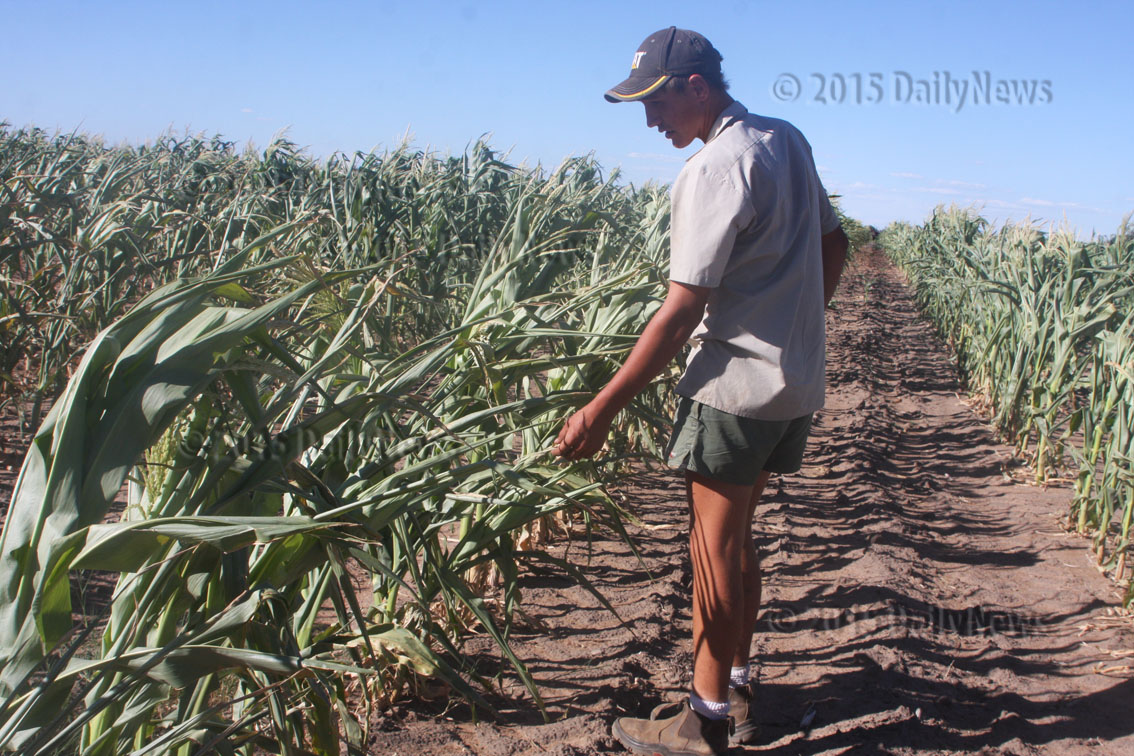
Mosisedi commercial dry land farmers are keeping their eyes on the sky hoping for a drop to save their dying crops.
“Even if it rains in the next 10 days, we might not get good crops but if it does not rain at all we are all doomed, “said Mr Cobus Botha in an interview.
He said they had planted 850 hectares expecting a yield worth about P10 million, but already there were patches where the seeds either did not germinate at all or had been scorched to death. He said they had so far replanted some portions several times as a result of the heat wave, but all their efforts went in vain.
Mr Botha said some of the maize was already flowering with four heads each but feared it might not survive the heat long enough, should it not rain.
As a precautionary measure, Mr Botha said they had planted their rows 2.3m wide to avoid crops competing for soil moisture. Another farmer, Mr Freddie Cronje said the total recorded rainfall for this season in their area did not even reach 100ml adding there was no moisture left in the soil at all now.
He feared he might not harvest anything at all in some blocks, adding he kept records for every block planted. Mr Cronje who planted 1800 hectares this season said 80 per cent was already damaged which he quantified as being worth P4.5 million.
He said he spent P6 million to plant the farm this season alone. “But, we might recover only 10 per cent if it rains in the next ten days or so otherwise it will be a complete blow, “he said. Before the damage, he said he had expected to yield about P1.5 million profit per hectare.
Mr Cronje said he had only the Agricultural Credit Guarantee Scheme (ACGS) to fall back on in the event government declared drought this season.
Through the scheme, which was only provided by the National Development Bank (NDB) and Citizen Entrepreneurship Development Agency (CEDA), he said a farmer paid 15 per cent of the loan while government contributed 85 per cent during a drought season.
Meanwhile, a milling business operator in Metlojane, Mrs Neo Mmolai also feared for her business. She said her business was dependent on the nearby farms to supply her with raw sorghum and maize.
She feared poor yields from the farms would kill her supply and adversely affect her business.
She said she was in a partnership with Sebube milling company to supply all the primary schools across the country with sorghum porridge. ENDS
Source : BOPA
Author : Topo Monngakgotla
Location : KANYE
Event : Interview
Date : 09 Feb 2015
Related News


03 Aug 2026
De Beers output surges in 2026 first-half

03 Aug 2026
VP urges investors to bet on startups

30 Jul 2026