



Water situation under control
15 Oct 2014
The Water Utilities Corporation (WUC) has put in place mechanisms to ensure that taps do not run dry.
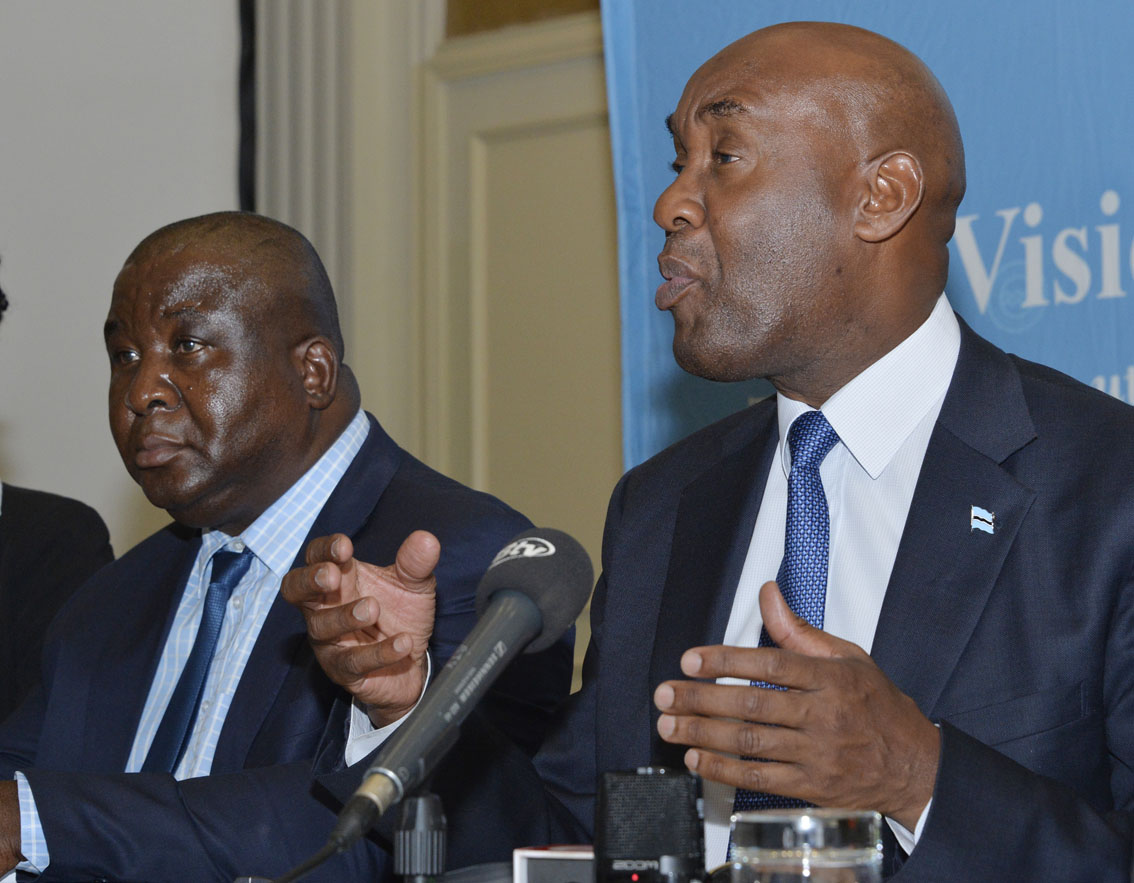
This is despite the fact that the Gaborone catchment area did not realise as much water as expected. The Minister of Minerals, Energy and Water Resources, Mr Kitso Mokaila said when addressing a press conference in Gaborone this week that remedial measures had been put in place to mitigate the impact.
“I think people take it for granted that water is generally just available and they don’t relate it to issues of rainfall, global warming and climate change and therefore the impacts on our lives. I think that relationship is very important,” the minister said.
Therefore, he said it was important that the nation was educated enough about the country’s water supply situation to ensure that they continued to utilise water responsibly.
The effective use and management of water, Mr Mokaila said, would help to curb water wastage amongst other challenges surrounding the current water supply situation in the country.
Currently, he said, Gaborone, Bokaa and Nnywane dams were in an unsatisfactory state with water levels of seven per cent, 27 per cent and 45 per cent respectively. This, he said, was translated to two months, five months and seven months of water supply, respectively.
This unsatisfactory situation of the dams in the south, he said, was exacerbated by the excessive monthly drop in water levels due to a combination of factors including overdraft from dams and high evaporation rates. The dams in the north, he said, remained in a healthy state of supply with most over 70 per cent full.
With Gaborone Dam sitting at seven per cent, he said the general output of the city, when it was all healthy, would be at 88 million litres a day, but was currently at 43 million litres a day. Generally, the greater Gaborone had a daily demand of 145 million litres of water a day and an average demand of 115 Ml a day from a population of 522 906 people.
This covered clusters of Mochudi with 58 604 people, Lobatse and Ramotswa with 100 325 people and Tlokweng and Mogoditshane with 363 977 people.
The North South Carrier (NSC), which would bring water from the north to the south, brought around 60 Ml of water a day into Gaborone. The Bokaa dam, Minister Mokaila said, contributed 28Ml of water a day to the greater Gaborone supply system, under normal circumstances. Currently, he said Bokaa dam’s levels were low, at 25 per cent and was only contributing 20 Ml per day.
“We will also get water out of Molatedi dam, from South Africa, which when we have our normal ration give us 20 Ml of water a day. But we have agreements that when it gets to 26 per cent and below, they give us half our allocation, which means 10 Ml of water a day,” he added.
In line with its Water Demand Management Strategy, he said WUC imposed various restrictions on water usage as and when the supplies dwindled and the set trigger levels for the relevant restriction were set off.
In case the Gaborone Dam could up, he said the Bokaa Dam would continue to give the 20 Ml, Molatedi would give half the allocation, Nnywane Dam would continue to give 2.5 Ml, whilst the six boreholes in Ramotswa would give an extra 8 Ml after the completion of the treatment plant, as well as what comes up from the NSC.
“Our general average usage after the restrictions comes to around 110 Ml and 115 Ml of water a day, being consumed. So, as I say your taps won’t run dry. It is dependent on all these scenarios remaining the same- the NSC being reliable and no failures on the NSC. And we have gone to great length to ensure that the NSC is safe,” he added.
In Botswana, Mr Mokaila said the main source of potable water was groundwater, which he said supplied an estimated 60 per cent of the population. However, he said groundwater resources were finite and non-renewable.
These limited recharge rates, he said, had over the years exacerbated the situation which was further aggravated by the deficient boreholes operational regime.
In the past few years, he said it had also been noted that during rainy seasons, the Gaborone Dam experienced continual low inflow into the dam, with the last spill over realised in the year 2000.
This low inflow, he said studies had also attributed it to the cumulative impact of numerous small dams that existed in the dam’s catchment area and the negative change in rainfall patterns. This, he said posed a challenge to the supply situation in the grater Gaborone area. ENDS
Source : BOPA
Author : Lorato Gaofise
Location : GABORONE
Event : Press conference
Date : 15 Oct 2014
Related News

07 Apr 2026
Nip Workplace Bullying In The Bud
07 Apr 2026
Kelebeng Appreciates Namibia Support
07 Apr 2026