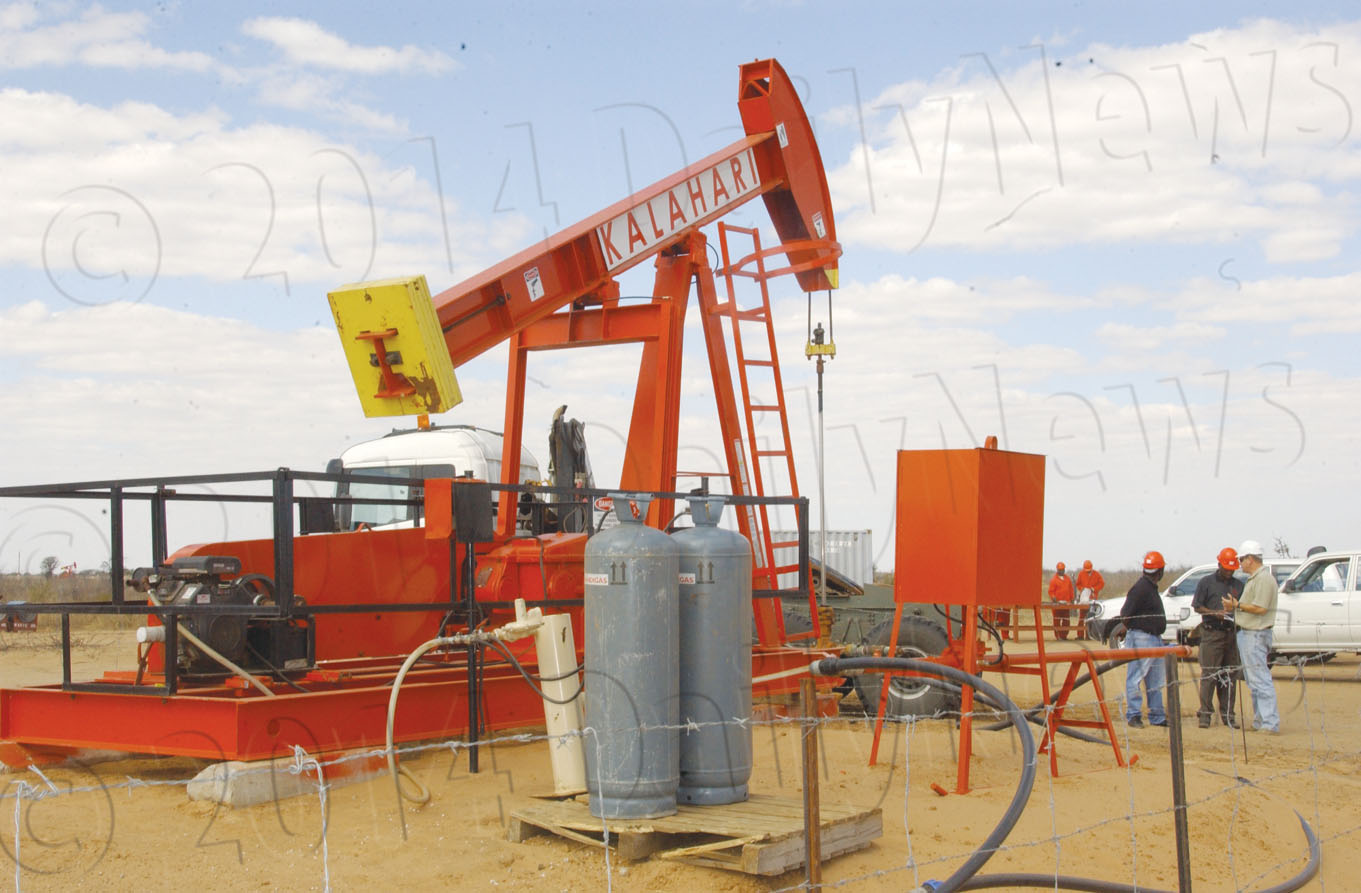
Kalahari Energy awaits customers
22 Jul 2014
The exploration of coal bed methane (CBM) in the central Botswana has yielded positive results so far, and companies are confident that they will soon garner a sustainable gas off-take agreement from customers who purchase in bulk.
Mr Mokwaledi Ntsimanyana, geologist at Kalahari Energy, said in an interview that the company has gathered positive results from drilling work and analysis information thus far and the only factor that is needed to develop a gas field is a customer who can commit to buying gas in bulk at an agreeable price.
He explained that the nature of consumers’ demand determines the type of infrastructure that will be put up and the economic feasibility of the project. Once a gas take off agreement has been secured, the company will have to institute an Environmental Impact Assessment (EIA), secure mining rights, water rights and surface rights, all of which can be completed in 18 months, after which full development can start.
“An estimate of 20 months is given for possible economic extraction of gas, provided there is a committed consumer ready to use the gas,” he said.
Mr Ntsimanyana said Kalahari Energy offers CBM as an alternative source of energy in Botswana, in view of the frequent power shortages in Southern Africa, ever escalating liquid fuels prices and the limited options available in the country’s energy-mix.
He said they were encouraged by the government of Botswana, which undertook a prefeasibility study on the potential of generating CBM from coal between 2000 and 2003. The study led to discovery of CBM in coal underlying the areas of Lephepe and Mmashoro.
“The gas can be extracted using conventional CBM technologies and has been flared at two pilot sites, Matikwe and Tsobu that lie southeast and southwest of Mmashoro, he said.
He confidently stated that there is CBM in Botswana coal as the feasibility study instituted by government estimated gas content approaching 196Tcf (5.6 trillion cubic metres) over a 50 000 km2 area underlain by Karoo carbonaceous sediments and coals.
Kalahari Energy’s leases fall within this area and the company has managed to drill 50 boreholes. The company’s area of leases covers 3912 km2 and contains a resource estimated at 9.787 Tcf (277 billion cubic metres). Mr Ntsimanyana said work is on –going to establish how much of this gas can be extracted using conventional CBM extraction technologies.
However, said Mr Nsimanyana, electricity generation is one of the more economically feasible ways of using CBM because it involves use of large quantities with tangible long term returns on the cost of investment on infrastructure and well field development.
This is more so because Botswana does not have a gas pipe line network for transporting, storing and supplying consumers.
“A gas pipe line is the most efficient means of transporting and storing gas. Without a pipeline network the only other way is to supply the gas as compressed natural gas (CNG). This would require establishment of cleaning and compressing facilities as well as tanker services,” he said.
He further revealed that Kalahari Energy envisages experimenting with this arrangement on a pilot scale in the near future. CBM as CNG can be used for domestic and industrial heating just like LPG (liquefied petroleum gas) and can also be used as motor vehicle fuel. Mr Ntsimanyana said the extraction of CBM will create jobs from the well field throughout to the gas distributor.
He said the project will also help reduce Botswana’s import energy bill and create spinoffs in the whole economy including transport, manufacturing down to households. Mr Ntsimanyana explained that at exploration stage the project is very technical and therefore does not employ many people.
However, he said support staff in the form drilling staff, contractors and house-keeping personnel often reaches appreciable numbers. Currently, Kalahari Energy has engaged Kalahari Gas Corporation (KGC) for its borehole drilling, construction and maintenance.
The field based staff compliment stands at 45 people. This number is expected to increase when contractors are engaged to provide specialist services and peak during the infrastructure development phase. The numbers will then level at around 100 people during the gas field operation stage.
Mr Ntsimanyana emphasized that the end use for gas will determine the numbers that will be employed. He also revealed that as at the end 2013, Kalahari Energy had spent P211 million across the concession areas.
“This figure covers drilling costs, salaries and wages, consultancies, assaying, permitting and running costs,” he said.
He explained that it costs around P1.5 million to drill a single CBM exploration well. With at least 200 wells to be drilled, plus connecting water and gas pipelines as well as setting up compression and cleaning infrastructure, it is likely that at least P1 billion will have to be spent.
Mr Tsimanyana said the CBM project is worthwhile because it has limited adverse environmental impact in the group of energy minerals.
“It makes sense to harvest CBM than let it self- discharge or be vented into the atmosphere as was the case prior to establishment of new coal mines. Also, CBM production water can be treated and used because it has the same common constituents found in natural waters,” he said.
He defended the use of hydro- fracturing, saying it’s a centuries old technology that has always been part of mining and excavation.
“It cannot suddenly go sour just because instead of explosives, water under pressure is used in a controlled manner to fracture underground rocks, specifically coal,” he said. ENDS
Source : BOPA
Author : Sefhako Sefhako
Location : SEROWE
Event : Interview
Date : 22 Jul 2014
Related News

04 Aug 2026
Farmers urged to prepare for El Nio

03 Aug 2026
De Beers output surges in 2026 first-half

03 Aug 2026